5% titanium dioxide in G2934Y matte, G1214Z1 matte, G2926B glossy
The body is Plainsman M390. The firing schedule is Plainsman PLC6DS. Of course, rutile could be used in place of titanium; it contains iron oxide that would enhance the development of blue. A small amount of cobalt can also be added to enhance the blue (the G2934 magnesia matte on the left, especially, will respond to that).

Related Pictures
Mason stains in the G2934 matte base glaze at cone 6
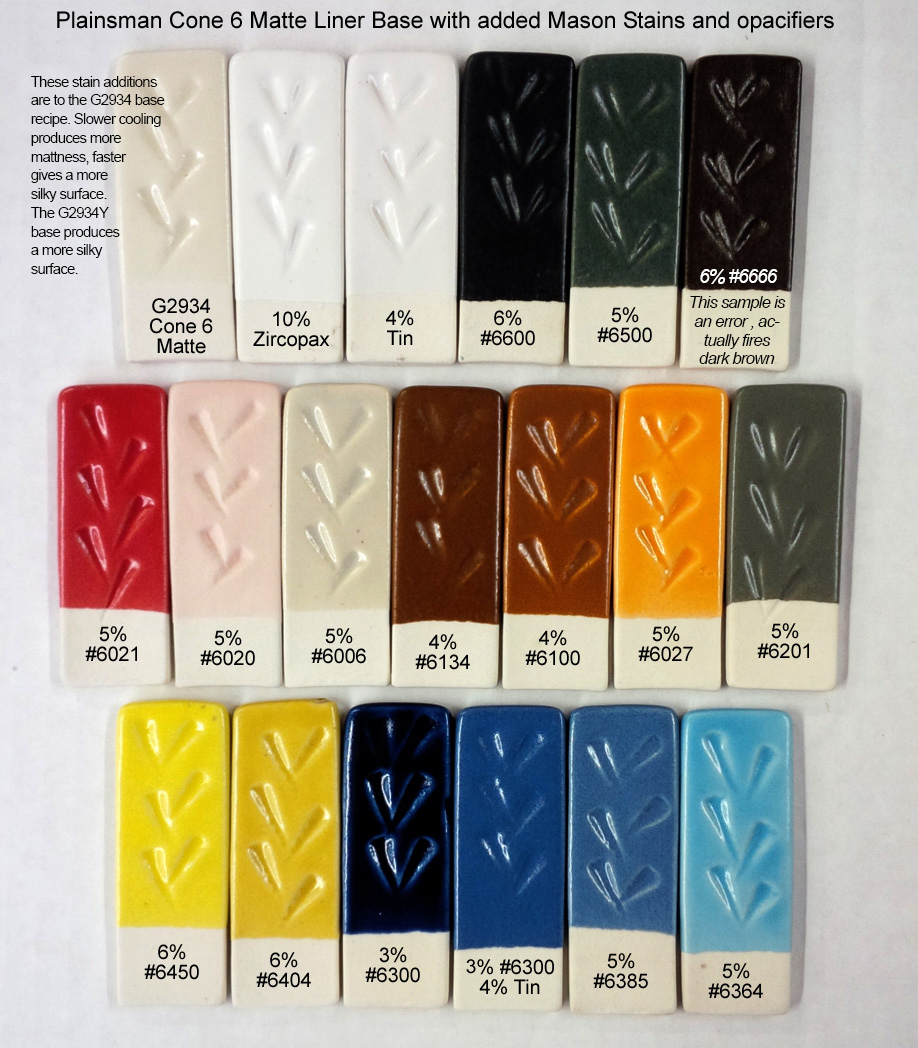
This picture has its own page with more detail, click here to see it.
Stains can work surprisingly well in matte base glazes like the DIY G2934 recipe. The glass is less transparent and so varying thicknesses do not produce as much variation in tint as glossy bases do. Notice how low many of the stain percentages are here, yet most of the colors are bright. We tested 6600, 6350, 6300, 6021 and 6404 overnight in lemon juice, they all passed leach-free. The 6385 is an error, it should be purple (that being said, do not use it, it is ugly in this base). And chrome-tin pink and maroon stains do not develop the color (e.g. 6006). But our G1214Z1 CaO-matte comes to the rescue, it both works better with some stains and has a more crystal matte surface. The degree-of-matteness of both can be tuned by cooling speed and blending in some G2926B glossy base. You can mix any of these into a brushing glaze or a dipping glaze. Be sure to blender mix them to break up any agglomerates.
Online Glaze Recipe Rescue:
Seeks good home for a magnesia matte blue
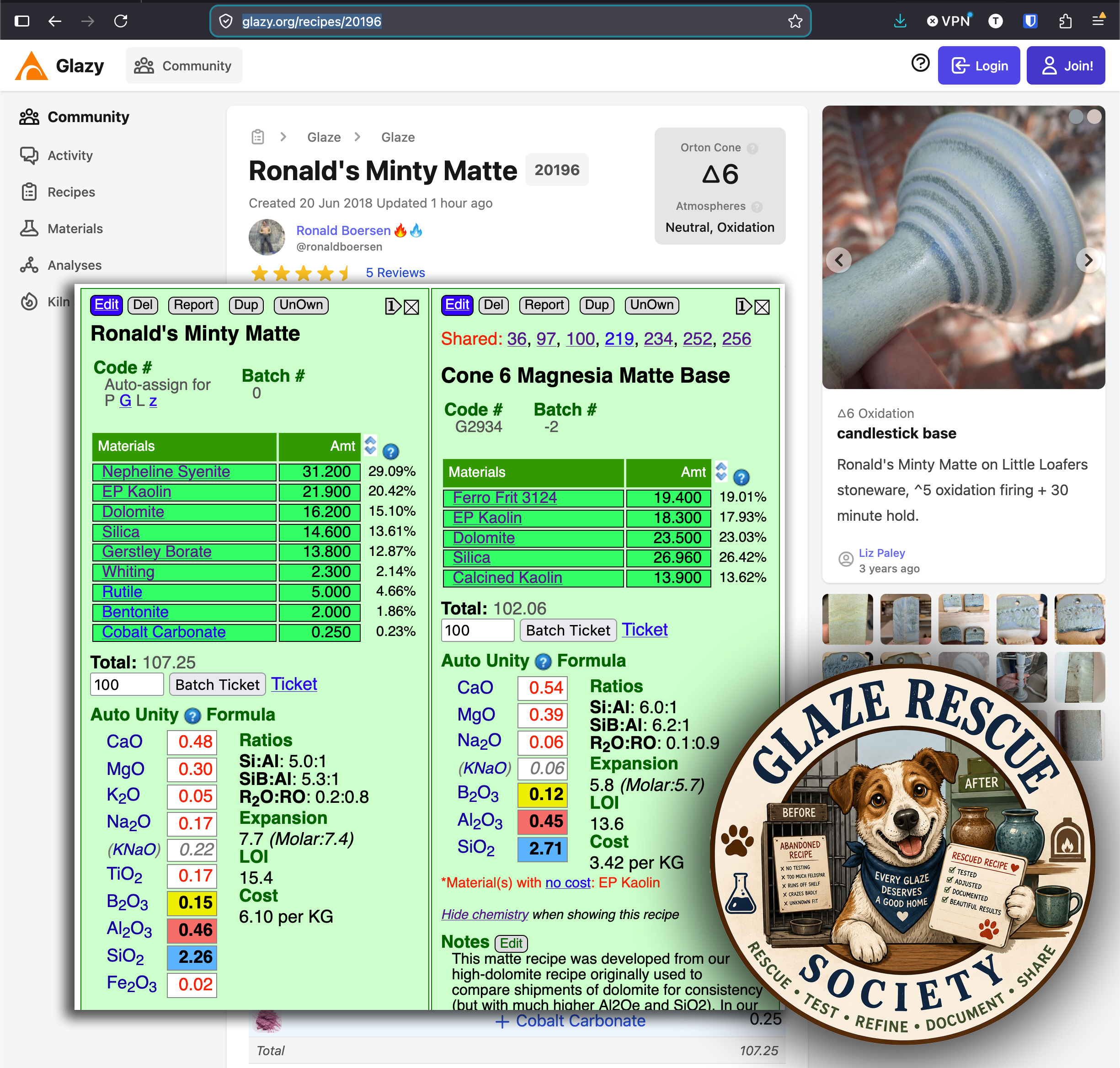
This picture has its own page with more detail, click here to see it.
This "Minty Matte" glaze was found wandering in a Facebook group. The current "home" is a base recipe having high nepheline syenite coupled with very low SiO2 (thus high COE). It crazes on most clay bodies used by the potter who contacted me. Its tag traced it to Glazy 20196. I sometimes think of these as "shelter recipes", needing a "glaze rescue". The beautiful appearance of this one provides the motivation to give it a little love and rehome it into a new base recipe! The love it needs is a simple understanding of the mechanism to move: It is rutile saturation in a magnesia matte with a little cobalt to kick the blue. Base recipes aren't carved in stone; the chemistry of this one can be altered to drop the COE a lot (by switching Na2O for MgO). G2934 magnesia matte also works with this mechanism (and has a much lower COE). Transplanting the rutile and cobalt into it would surely reduce crazing.
However, this recipe needs another rescue. From a misunderstanding. Although the potter contacting me was happy with the G2934 as a base for the rutile and cobalt, she had learned that durable glazes should have an R2O vs RO Ratio of around 0.3:0.7 (G2934 is 0.1:0.9). However, the R2O:RO ratio thing is misunderstood. Durability is much more about producing a well-melted homogeneous glass (but not over-fluid) with minimal phase separation and surface crystallization, good body fit and absence of large amounts of easily dissolved colorants.
Links
| Glossary |
Opacifier
Glaze opacity refers to the degree to which it is opaque. Opacifiers are powders added to transparent ceramic glazes to make them opaque. |
| Materials |
Zircon
Zircon (zirconium silicate) is a hard, dense, refractory ceramic material used to opacify pottery glazes and in refractory products such as kiln washes, crucibl |
| Materials |
Tin Oxide
Its principle use in ceramics is as an opacifier in glazes. It is very expensive. |
| Recipes |
G1214Z1 - Cone 6 Silky CaO matte base glaze
This glaze was born as a demonstration of how to use chemistry to convert a glossy cone 6 glaze into a matte. |
| Recipes |
G2934Y - Cone 6 Magnesia Matte Low LOI Version
The same chemistry as the widely used G2934 but the MgO is sourced from a frit and talc instead of dolomite. It has a finer surface, less cutlery marking and staining. |
 PayPal | No tracking, No ads, No paywall, No transient content! Just organized, concise information constantly updated and improved. Was this helpful? Consider supporting me. |
Got a Question?
Buy me a coffee and we can talk 

https://backup.digitalfire.com, All Rights Reserved
Privacy Policy