Applying an engobe by pouring or spraying
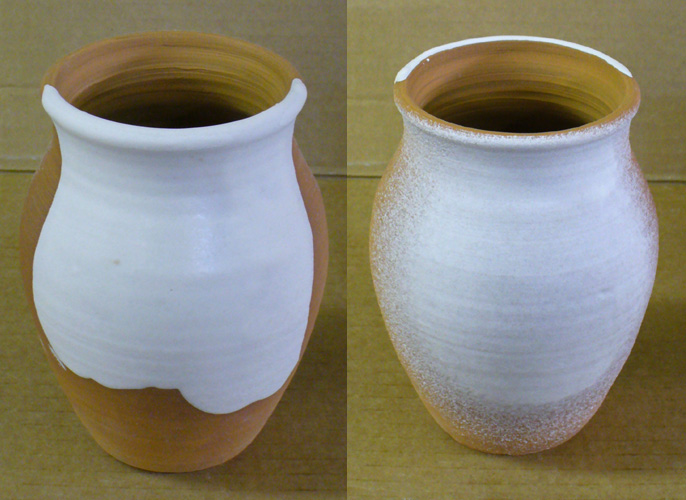
An example of an engobe (slip) applied to dry ware and then fired at cone 2. The one of the left has been poured, the right sprayed. Control of the thickness of engobes is important, thus the specific gravity and viscosity of the slurries are very important. Engobes are invaluable since a red or brown burning body can be made to fire white like porcelain (enabling much better glaze surface quality).
Related Pictures
Here’s why engobes shouldn’t melt
And also why they needn't contain zircon

This picture has its own page with more detail, click here to see it.
Since white burning slips are made from refractory materials they are not nearly as vitreous as terracotta bodies, they need help to mature and a frit is the natural answer. With the right amount, fired shrinkage can be matched to the body while the slip remains opaque.
L3685A slip on the left: An adjustment to the popular "Fish Sauce" recipe (which is basically a super plastic white body). 8% Frit 3110 replaces 8% Pyrax to make it glass-bond to the body better while remaining completely opaque.
Right L3685C: It has 15% frit, moving it into glaze territory, with translucency replacing opacity. Although expensive zircon could be added to restore opacity, that doesn’t fix the excessive firing shrinkage it now has, mismatching it with the body (which becomes more eventful the thicker it is applied).
Links
| Articles |
Creating a Non-Glaze Ceramic Slip or Engobe
It can be difficult to find an engobe that is drying and firing compatible with your body. It is better to understand, formulate and tune your own slip to your own body, glaze and process. |
| Glossary |
Pour Glazing
A method of applying glaze evenly and quickly to pottery. |
 PayPal | No tracking, No ads, No paywall, No transient content! Just organized, concise information constantly updated and improved. Was this helpful? Consider supporting me. |
Got a Question?
Buy me a coffee and we can talk 

https://backup.digitalfire.com, All Rights Reserved
Privacy Policy