Common North American pottery frits:
Do you know what each one is used for?
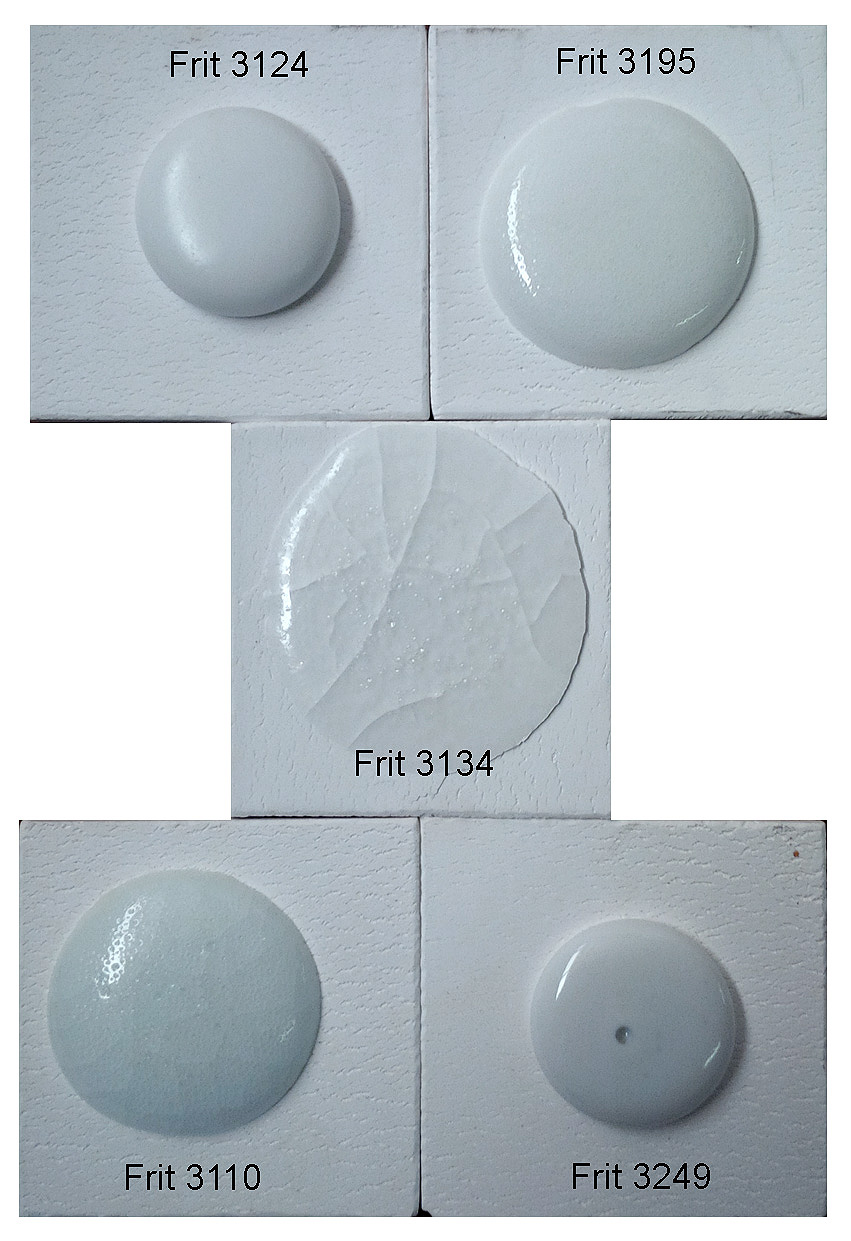
These 10-gram GBMF test balls were melted at 1850F.
Chart showing the chemical analysis of each (tap/click the triangle)
| Ferro | Frit 3134 | Frit 3124 | Frit 3195 | Frit 3110 | Frit 3249 |
|---|---|---|---|---|---|
| MgO | 12.2 | ||||
| CaO | 19.5 | 14.3 | 11.4 | 6.3 | 3.5 |
| Na2O | 10.1 | 6.4 | 5.7 | 15.2 | |
| Al2O3 | 2 | 10 | 12 | 3.7 | 13.3 |
| B2O3 | 22.8 | 13.7 | 22.6 | 2.6 | 28.9 |
| K2O | 0.7 | 2.4 | |||
| SiO2 | 45.6 | 54.9 | 48.3 | 69.8 | 42.1 |
| COE | 9.5 | 8 | 7 | 10 | 4 |
| Si:Al Ratio | 38.7:1 | 9.3:1 | 6.8:1 | 32:1 | 5.4:1 |
| R2O:RO Ratio | 0.3:0.7 | 0.3:0.7 | 0.3:0.7 | 0.7:0.3 | |
- 3124, 3134 and 3195 are boron-melted and have R2O:RO ratios of 0.3:0.7. 3124 and 3195 are glaze-like and can be turned into transparent low-temperature glossy glazes with a simple 10-15% kaolin addition (in stoneware glazes they comprise ~20-40%). 3195 has lower Si:Al ratio, so it is not as glossy.
- 3134 is not glaze-like (its Si:Al ratio is 39:1, B2O3 is very high, and its high thermal expansion would craze on any clay body). Its role is as a "B2O3 source" for glazes (add it to make them melt more while having a low probability of upsetting other aspects of the chemistry).
- High-soda 3110 is a "crackle glaze minus the kaolin". It has so much Na2O that it doesn't even need high-boron to melt it. The button has cracked like the 3134. 3110 raises the thermal expansion of glazes. 3110 is the best frit for use in bodies, a super-feldspar.
- The high-magnesia, high-boron 3249 is made for the abrasives industry. But it delivers the same oxides we use in ceramic glazes. Its high-magnesia is the best strategy for holding down thermal expansion of glazes and producing MgO mattes. Its high B2O3 is the key to how a formulation with this much MgO can melt this well.
Related Pictures
Notice the distinct frit melting patterns:
Can you pick two that share similar chemistry?

This picture has its own page with more detail, click here to see it.
These 10g balls GBMF test balls were fired far lower than typical bisque; notice how many of them are already melting well! Frit 3602 is lead bisilicate. Maybe you always thought lead was the best melter. But it got "smoked" by the Fusion FZ-16 high-zinc, high-boron, zero-alumina frit! However, notice the FZ-16 is crazing badly; that is a problem for many applications using this high KNaO frit. Want to get some of this frit for pottery? You can't; Fusion Ceramics doesn't want to handle retail sales of smaller quantities.
Notice that, at this low temperature, each frit has a distinctive melt fingerprint that makes it recognizable.
Notice that the common North American pottery frits on the bottom row: 3195, 3249, 3124, 3110 (and 3134 in the second row) fire distinctly differently. Notice Fusion F69. It looks like 3249 because it is a substitute for it! F-75 is a substitute for 3110 (sharing the same melting pattern but having different micro-bubble clouding).
Links
| Materials |
Ferro Frit 3124
A commonly available calcium borosilicate frit. It is glaze-like, needing only a kaolin addition to create a low-temperature glossy glaze. |
| Materials |
Ferro Frit 3134
A frit with 23% B2O3. The most common of frits used in pottery in North America. Around the world, other companies make frits of equivalent chemistry. |
| Materials |
Ferro Frit 3195
A commonly available calcium borosilicate frit. It is glaze-like, needing only a kaolin addition to create a low-temperature semi-glossy glaze. |
| Materials |
Ferro Frit 3110
High sodium, high thermal expansion low boron frit. A super-feldspar in clay bodies. Melts at very low temperatures. Useful to make crackle glazes. |
| Materials |
Ferro Frit 3249
A magnesia borosilicate frit. Very low thermal expansion. Invaluable for increasing the MgO in glazes (to prevent crazing and create matteness). Low melting. |
| Glossary |
Chemical Analysis
In ceramics, raw material chemistry is expressed a chemical analyses. This is in contrast to fired glaze chemistries which are expressed as oxide formulas. |
 PayPal | No tracking, No ads, No paywall, No transient content! Just organized, concise information constantly updated and improved. Was this helpful? Consider supporting me. |
Got a Question?
Buy me a coffee and we can talk 

https://backup.digitalfire.com, All Rights Reserved
Privacy Policy