Cone 10R clear glaze made more "clear":
Using frit to source Na2O instead of feldspar
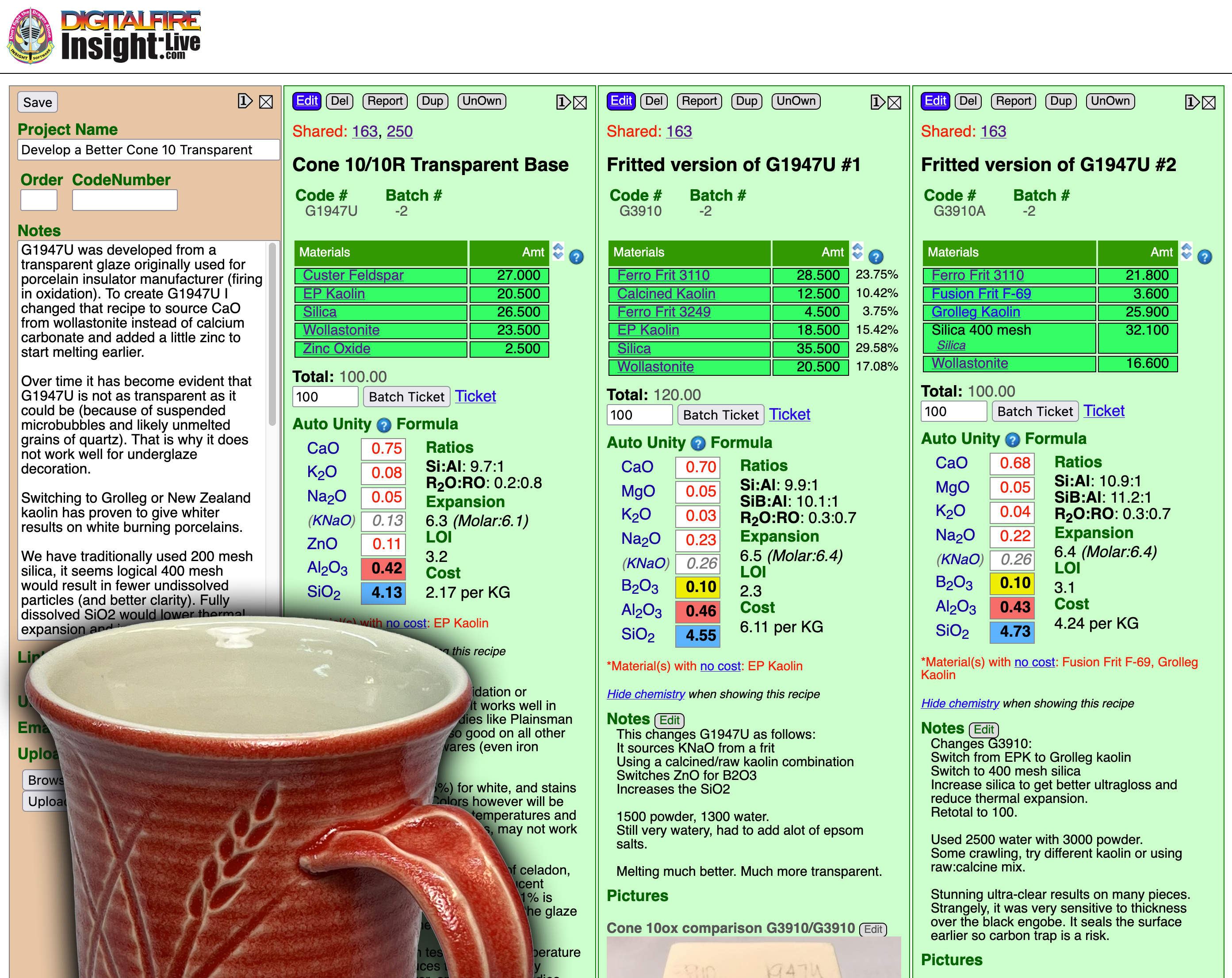
To get a better, more brilliant transparency than G1947U, at cone 10R, I tried sourcing Na2O from a frit. The inside surface on this mug is the result (v2), it is so glossy it looks like a low-fire leaded glaze. This screenshot of side-by-side panels shows the frit-enhanced version(s), G3910 and G3910A. Frit 3110 has a much higher concentration of KNaO than the feldspar, a key to making a brilliant glass. While this increases the COE, the fact that it comes from this frit brings multiple benefits:
-A brings a little B2O3, a better melter than zinc (which volatilizes anyway at cone 10).
-It dissolves more low-expansion glass-forming SiO2 (in v2 I switched to 400 mesh silica to enhance that even more).
-The glaze can then tolerate some low-expansion MgO (introduced by Frit 3249 or its equivalent, Fusion Frit F-69).
More details about this project can be found by clicking/tapping the Insight-live recipe code numbers G1947U, G3910 or G3910A. The red outside glaze is G2571D1.
Related Pictures
Frit vs Feldspar in a cone 10 glaze:
A good reason to do that.
This picture has its own page with more detail, click here to see it.
I calculated a frit-based recipe to match the original G1947U Cone 10R clear feldspar-based one. Only after seeing the fired results did I fully realize how much better it melts and how much more transparent it fires. It costs more money to make, but in some situations it is worth it.
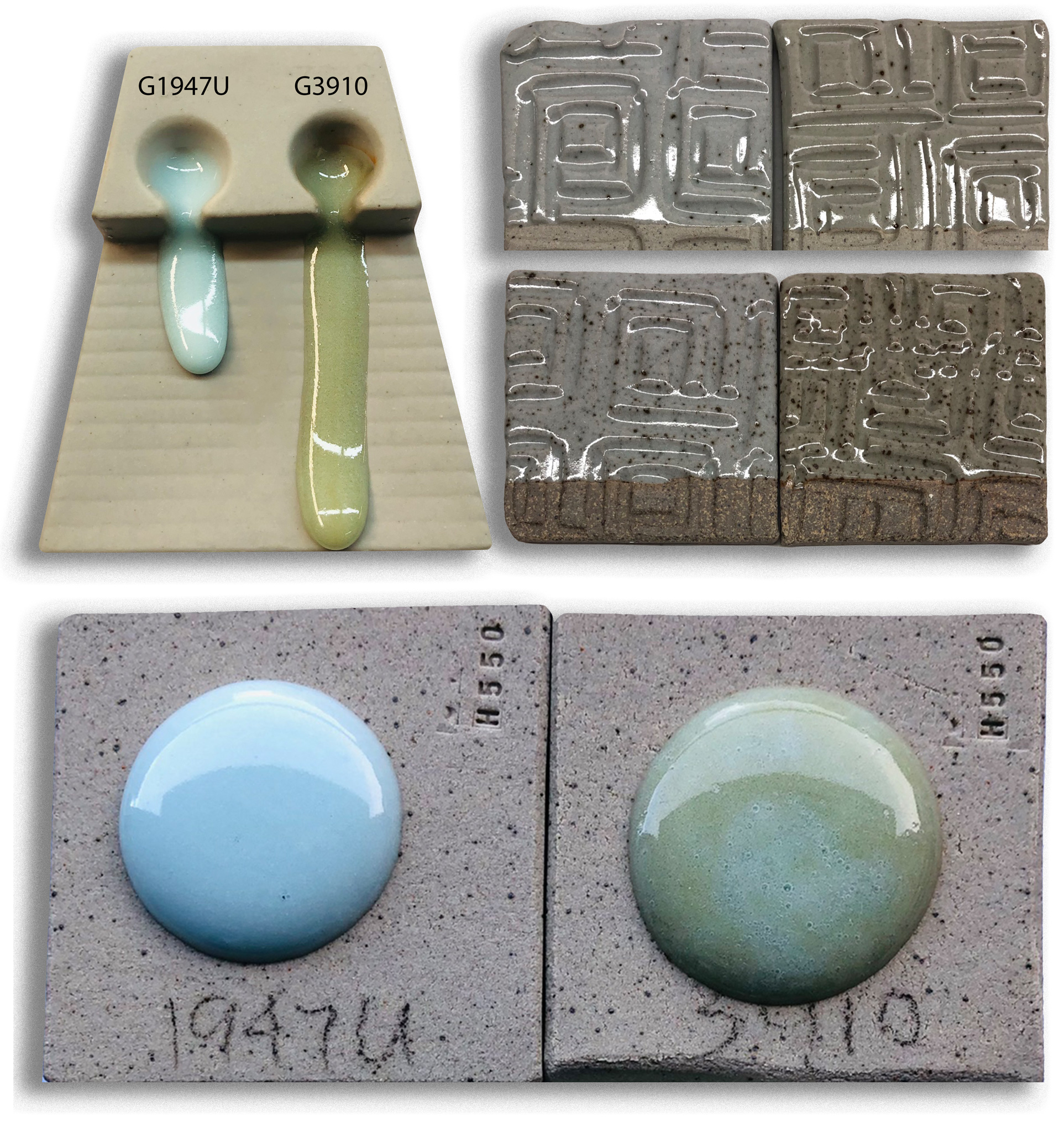
My original approach was just theoretical: Shift KNaO-sourcing from feldspar to frit to get a better melt. As calculations took shape, it became clear that I could increase KNaO because it enabled increasing SiO2 also. When the kiln opened, I got a surprise with the original G1947U: It never looked white on the ware, but when seeing it thick like on this GBMF test (bottom), it looks really cloudy. Likely the melt is not completely dissolving the particles of quartz! The surface brilliance of the new G3910 blew me away at first; it really is better (top right is G1947U left, G3910 right on buff and brown bodies). This glaze develops a better interface with the body and on porcelains, it is more crystal clear and much brighter.
Click here for case-studies of Insight-Live fixing problems

This picture has its own page with more detail, click here to see it.
You will see examples of replacing unavailable materials (especially frits), fixing various issues (e.g. running, crazing, settling), making them melt more, adjusting matteness, etc. Insight-Live has an extensive help system (the round blue icon on the left) that also deals with fixing real-world problems and understanding glazes and clay bodies.
Links
| Typecodes |
Glaze Chemistry
Case studies where glaze chemistry was used to solve a problem. |
| Materials |
Ferro Frit 3249
A magnesia borosilicate frit. Very low thermal expansion. Invaluable for increasing the MgO in glazes (to prevent crazing and create matteness). Low melting. |
 PayPal | No tracking, No ads, No paywall, No transient content! Just organized, concise information constantly updated and improved. Was this helpful? Consider supporting me. |
Got a Question?
Buy me a coffee and we can talk 

https://backup.digitalfire.com, All Rights Reserved
Privacy Policy