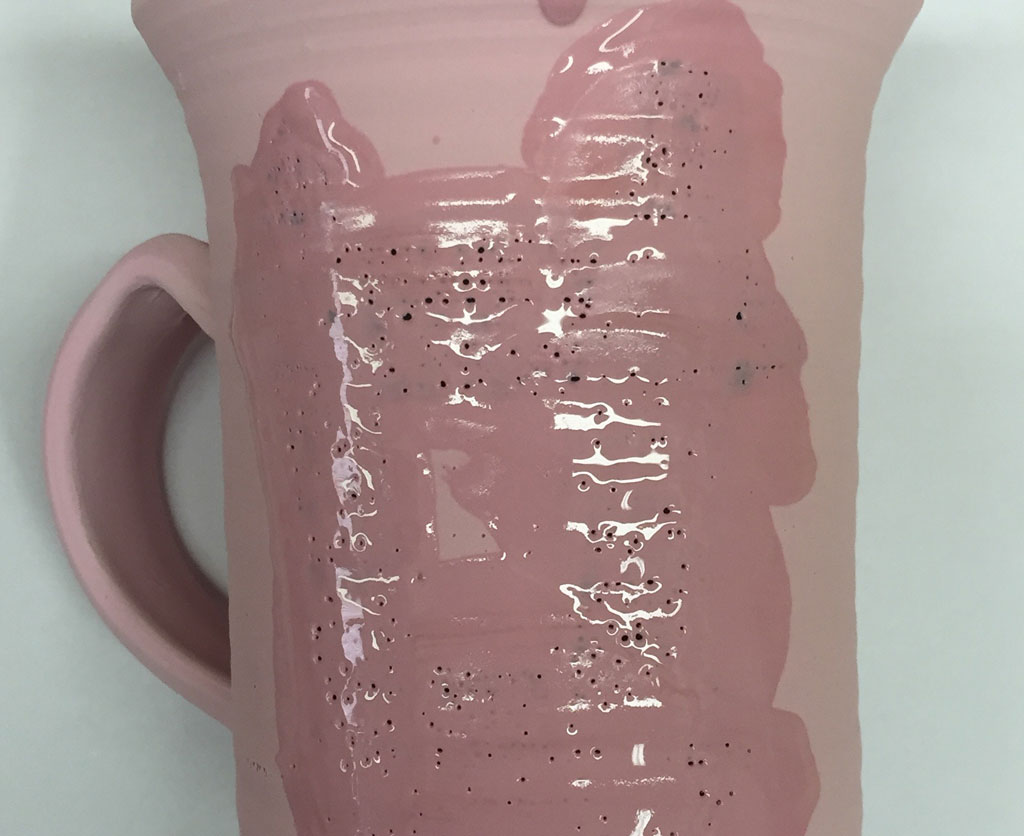
Underglaze decoration difficult to cover with clear overglaze
The underglaze was painted on to bisque ware (has not be fired on). This is a problem. It has a high gum content and has sealed the surface so the porous body underneath is unable to pull water out to dry it quickly. During the slow dry the little absorption that is taking place is generating air bubbles from below and these are producing bare spots. The solution is to either make your own underglaze having a lower gum content or decorate ware in the dry or leather hard stage so the bisque fire will neutralize the gum.
Related Pictures
A reason for DIY underglazes:
To better accept a clear dipping overglaze

This picture has its own page with more detail, click here to see it.
The commercial product has two issues. First, it is just not covering well enough; to get jet black requires three or four coats. Second, it is intended for transparent brushing glazes over top - dipping glazes do not cover well over it, even when the underglaze is bisque fired (upper left). By contrast, my own black (90% MNP, 10% Nepheline Syenite, 10% black stain, 1.5% CMC gum, 5% bentonite) overglazes perfectly (upper right). And one brush stroke almost covers enough for the black (I later settled on 15% stain for consistent dense color with one stroke).
Links
| Glossary |
Underglaze
Understand pottery underglazes: Why they brush differently, how they fire, why clears fail over them, and how to make your own recipes. In technical rather than art language. |
| Materials |
CMC Gum
CMC gum is indispensable for many types of ceramic glazes. It is a glue and is mainly used to slow drying and improve adhesion and dry hardness. |
 PayPal | No tracking, No ads, No paywall, No transient content! Just organized, concise information constantly updated and improved. Was this helpful? Consider supporting me. |
Got a Question?
Buy me a coffee and we can talk 

https://backup.digitalfire.com, All Rights Reserved
Privacy Policy