Here’s why engobes shouldn’t melt
And also why they needn't contain zircon
Since white burning slips are made from refractory materials they are not nearly as vitreous as terracotta bodies, they need help to mature and a frit is the natural answer. With the right amount, fired shrinkage can be matched to the body while the slip remains opaque.
L3685A slip on the left: An adjustment to the popular "Fish Sauce" recipe (which is basically a super plastic white body). 8% Frit 3110 replaces 8% Pyrax to make it glass-bond to the body better while remaining completely opaque.
Right L3685C: It has 15% frit, moving it into glaze territory, with translucency replacing opacity. Although expensive zircon could be added to restore opacity, that doesn’t fix the excessive firing shrinkage it now has, mismatching it with the body (which becomes more eventful the thicker it is applied).

Related Pictures
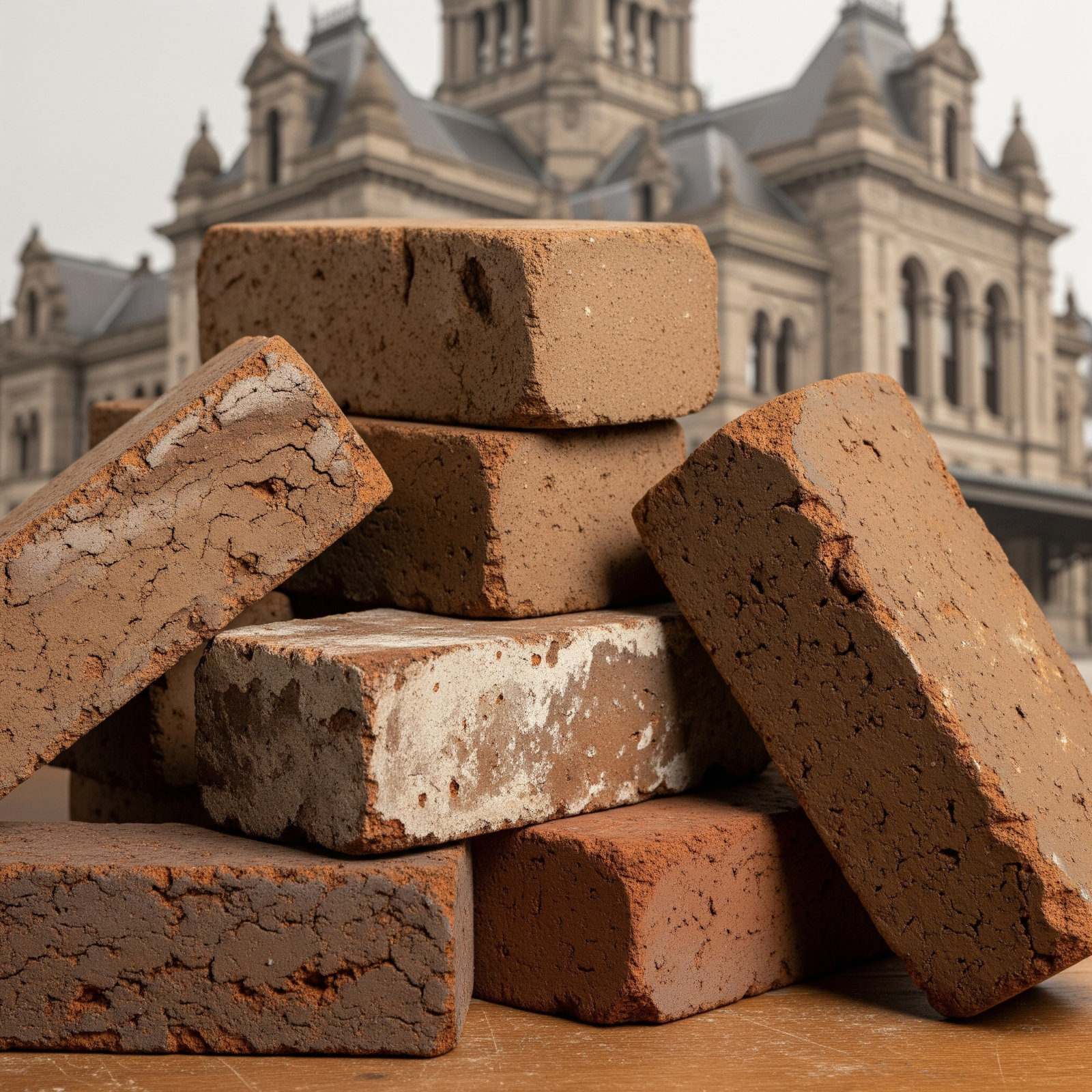
Color matching restoration project: Engobe on fired brick
This picture has its own page with more detail, click here to see it.
A building restoration specialist is developing an engobe recipe to apply to already-fired solid bricks (to match the facade of a historic building). This is challenging because engobes are normally applied at leather-hard stage (thus dry and fire shrinking with the body). Of course, the fired color, character and weather durability are most important; but, to be usable, this recipe needed other properties: Good adherence to the surface and ability to stay adhered during firing (thus low drying shrinkage and low firing shrinkage). That is the reason for the CMC gum, calcined versions of the clays, the grog, and the wollastonite.
Red Art - 10
Calcined RedArt - 10
Calcined kaolin - 10
Calcined ball clay - 10
Calcined Newman Red fireclay - 5
Ferro Frit 3110 - 25
Grog - 30
Wollastonite - 10
CMC Gum - 1
The percentage of frit is very important; it can only be determined by testing. Too much and the firing shrinkage will be excessive (it will flake off). Too little and the durability and weather resistance won't be sufficient. If a sufficiently durable surface cannot be achieved, then multiple layers that transition from hard surface to the brick substrate might be another approach.
White engobe flaking off terra cotta tiles

This picture has its own page with more detail, click here to see it.
Ideally, engobes are applied at leather hard stage. Their body-like makeup enables a plastic bond (#1) and their body-matching fired shrinkage (#2) and COE (#3) maintain that bond through the firing. That being said, many companies turn this logic on end and apply engobes at the bisque stage - where mechanism #1 is missing and they ignore fired fit #2 and #3. An example is terra cotta tile, companies buy it in bisque form, apply the engobe and then a glaze over that. And somehow it works! Or, at least, appears to work. But here is a time it does not. And how often are the tiles flaking time bombs?
How do this company, and others, get away with this most of the time? One secret is initial laydown - This mix is converted to paint by the addition of CMC gum. Second, it is sprayed on in an even and just thick enough layer. Third, 10% frit is added, enough to start melting (usually augmented by high zircon content), this can crowbar adhesion enough. These measures, most of the time, are enough it ignore #2 and #3 and so the item survives firing and light-duty use.
This company does not have the flexibility to do the ideal, they don't make the tile. What can they do? Discover the right balance between adhesion and fired fit. Do EBCT testing by cutting a tile into thin slices, applying the slip and noting the bend. If the fit is way off then start testing using the L3685Z5 recipe, tuning the amount of frit to get best compatibility. Then increasing it until too much opacity is lost or flaking occurs. Then decide on a compromise percentage between bond and fit.
A reason for DIY underglazes:
Ability to use a lower percentage of stain

This picture has its own page with more detail, click here to see it.
These four commercial hobby underglazes were fired side-by-side in melt-fluidity testers at cone 8. The blue and green remain comparatively refractory, the pink has begun to soften and flow, and the black has become highly fluid. These differences reflect the behaviour of the complete formulations, not just the stains. But ceramic stains themselves differ greatly in color strength, refractoriness, particle characteristics and interaction with a ceramic medium.
Manufacturers face a difficult compromise because many underglazes are advertised for use across a very wide temperature range. Some colors need much more stain than others to remain intense, and each stain can change the suspension, drying and fired properties of the product. A broadly useful base will therefore be underfired for one color and excessively melted for another. While manufacturers can compensate by adjusting the base, stain loading or opacity, the results at any one temperature can still differ dramatically.
A DIY approach can target your actual firing temperature. Begin with a compatible engobe or underglaze base (e.g. L3954B) and estimate the stain requirement—for example, relatively little for a strong blue or black and considerably more for some yellows and pinks. Then adjust the frit/feldspar until the underglaze bonds well without developing enough to lose opacity. Finally, fine-tune the stain percentage and adjust the medium. Done well, strong blues and blacks can be bright and opaque with less than 10% stain.
Applying an engobe by pouring or spraying
This picture has its own page with more detail, click here to see it.
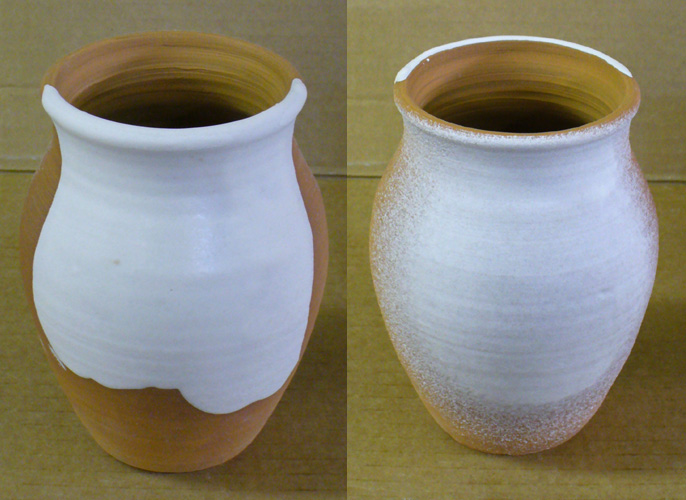
An example of an engobe (slip) applied to dry ware and then fired at cone 2. The one of the left has been poured, the right sprayed. Control of the thickness of engobes is important, thus the specific gravity and viscosity of the slurries are very important. Engobes are invaluable since a red or brown burning body can be made to fire white like porcelain (enabling much better glaze surface quality).
Potters can learn from how glazes are fit on ceramic tile

This picture has its own page with more detail, click here to see it.
These are thermal expansion curves for body, engobe and glaze (from a dilatometer, a device that measures it against increasing temperature). The upper line is the body. The center line is the engobe. The lower line is the glaze. The ceramic tile industry is very conscious, not only of glaze-fit but also engobe-fit. Engobes (slips) are employed to cover brown or red burning bodies so they glaze like a porcelain. Typically technicians tune the formulation of the engobe to have an expansion between the body and glaze. The body is highest so that during cooling, as it contracts, it puts a squeeze on the engobe (the engobe thus never finds itself under tension). The glaze has the lowest expansion, it is under a state of compression by the engobe (and slightly more by the body). This equilibrium enables the tile to wear for many years without crazing or shivering. Chart courtesy of Mohamed Abdelmagid.
Bi-Clay strips test compatibility between engobe and body

This picture has its own page with more detail, click here to see it.
Slips and engobes are fool-proof, right? Just mix the recipe you found on the internet, or that someone else recommends, and you are good to go. Wrong! Low fire slips need to be compatible with the body in two principle ways: drying and firing. Terra cotta bodies have low shrinkage at cone 06-04 (but high at cone 02). The percentage of frit in the engobe determines its firing shrinkage at each of those temperatures. Too much and the engobe is stretched on, too little and it is under compression. The lower the frit the less the glass-bonding with the body and the more chance of flaking if they do fit well (either during the firing or after the customer stresses your product). The engobe also needs to shrink with the body during drying. How can you measure compatibility? Bi-body strips. First I prepare a plastic sample of the engobe. Then I roll 4 mm thick slabs of it and the body, lay them face-to-face and roll that down to 4 mm again. I cut 2.5x12 cm bars and dry and fire them. The curling indicates misfit. This engobe needs more plastic clay (so it dry-shrinks more) and less frit (to shrink less on firing).
Links
| Glossary |
Opacity
Opacity of ceramics glazes is normally achieved by adding an opacifier like tin oxide or zircon. However, there are chemical profiles that can turn transparent glazes milky and make it cheaper to opacify them. |
| Glossary |
Engobe
Engobes are high-clay slurries that are applied to leather hard or dry ceramics. They fire opaque and are used for functional or decorative purposes. They are formulated to match the firing shrinkage and thermal expansion of the body. |
| Recipes |
L3685U - Cone 03 White Engobe Recipe
A white burning body with enough added frit to produce a cone 03 stoneware or white slip for use on the matching red Zero3 stoneware. |
| Articles |
Creating a Non-Glaze Ceramic Slip or Engobe
It can be difficult to find an engobe that is drying and firing compatible with your body. It is better to understand, formulate and tune your own slip to your own body, glaze and process. |
 PayPal | No tracking, No ads, No paywall, No transient content! Just organized, concise information constantly updated and improved. Was this helpful? Consider supporting me. |
Got a Question?
Buy me a coffee and we can talk 

https://backup.digitalfire.com, All Rights Reserved
Privacy Policy