A special gummed engobe made this possible
The fired pieces appear to be made from black porcelain. But this is L3954F cone 6 black engobe over a white porcelain. Multiple factors make this work. First, a non-gummed dipping engobe will not work for this (it will not apply by brush evenly or thickly enough). This brushing version mixes 500 grams of L3954F powder (with black stain) into 280g water and 75g of Laguna Gum Solution. Second, the engobe recipe is tuned to have the same degree of vitrification as the body, in this case M370, so pieces don’t stick to the kiln shelf during firing. Of course, this procedure rewetted the bases of the leather hard mugs, extending drying time so extra precautions were needed to avoid cracking. For example, I painted wax emulsion on the handle outers and covered them all in cloth and plastic for a day to slow down drying.

Related Pictures
Make a black engobe to fit your stoneware perfectly
This picture has its own page with more detail, click here to see it.
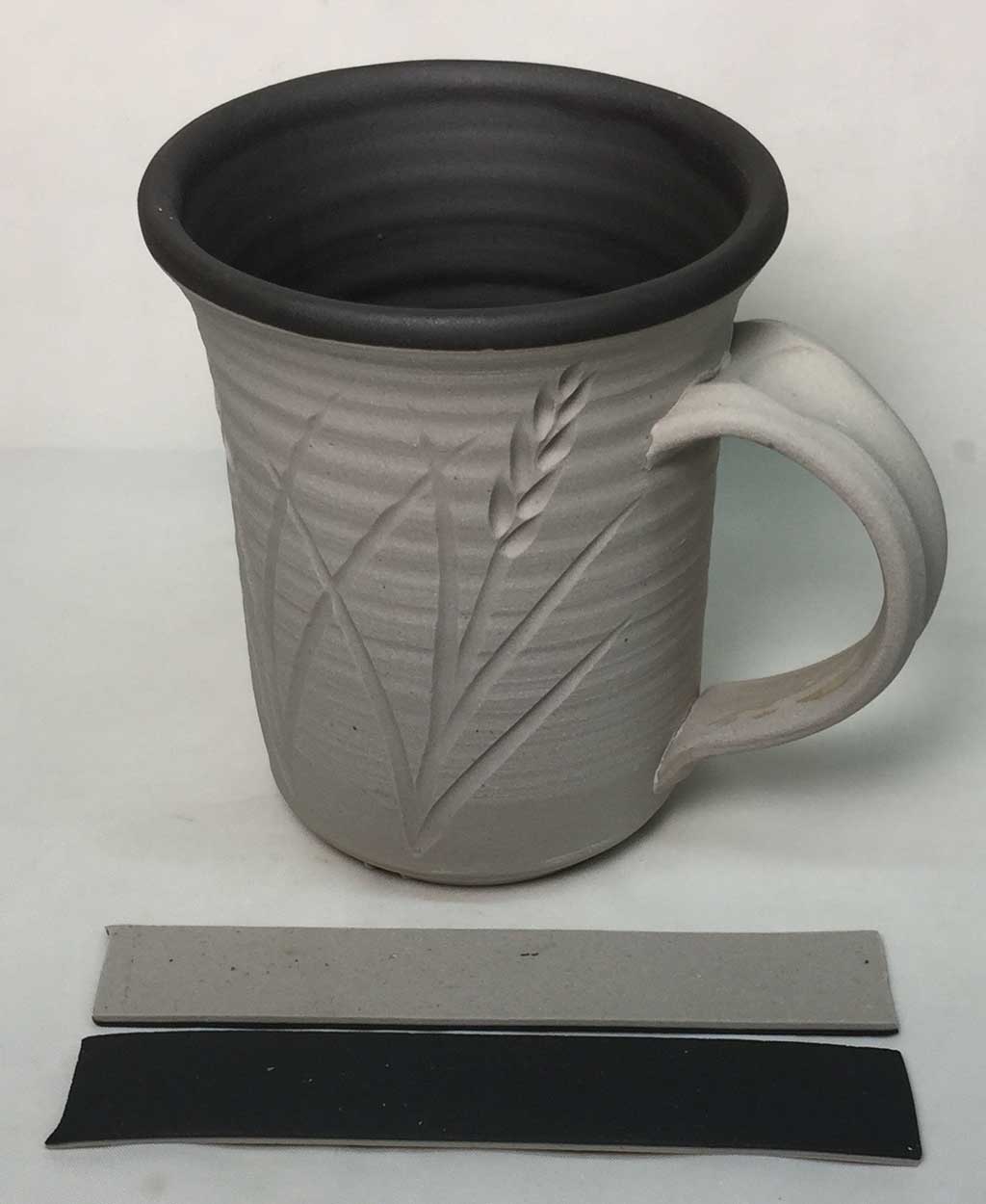
This unglazed white stoneware mug has been fired to cone 10R (Plainsman H570, 0.5-1% porosity) to demonstrate the utility of a stained engobe, in this case L3954J. This recipe employs 10% Mason 6600. The firing schedule is C10RPL. Notice the EBCT test bars in front; I make these by sandwiching the body and the engobe together in a thin strip, they demonstrate engobe/body compatibility because differences in drying and fired shrinkage curl the bar (toward the one of higher shrinkage). Thus, the straighter the bars dry and fire, the better the engobe-body fit. This makes it practical to tune an engobe to fit any clay body (e.g. my regular L3954N engobe recipe for buff stoneware adjusts this to have a lower fired shrinkage). This is not something to ignore, engobes that don't "fit" can flake off or exhibit issues similar to glaze compression. An organized testing program is ideal to be able to use engobes. While stains are not common at this high of a temperature, my testing has shown good results on many colors. The Mason Colors data sheets show this stain (and their 6666 cobalt-free one) to be suitable as body stains up to 2300F (1260C) - cone 10 is technically a little above this limit but I have not encountered issues. Black engobe work very well at lower temperatures, e.g. my L3954B recipe.
The best way to make black clay:
Don't. Use an engobe instead.

This picture has its own page with more detail, click here to see it.
Consider the mug on the left, a version of L4768E. This is not the best way, but it is the one most used at cone 6 oxidation (and what Plainsman Clays does with Coffee Clay). This is a DIY mix, the darkest that it is practical (I used the hyper-red burning C-Red clay as a base, thus needing much less umber to darken it). While it looks black beside red burning bodies, beside this true black, it doesn't. First, it is not a body; it is just a thin veneer of stained porcelain engobe. Why is this such a good idea? If the surface is all we see, why stain it all the way through? That being said, some people need a totally black and safe clay, like this one, and can afford to make it themselves (if that is you, try using the L4053B recipe as a starter). Get a plaster table and a propeller mixer and you will be unstoppable!
What about using metal oxides to make the engobe? Black stain is expensive but is far superior (and safer) for black. Consider using 10-15% colorant in this 500g mug, which would require 50-75 grams of stain (~$5-8). 10% stain in an engobe applied in this thin layer likely needs only a few grams of stain (for pennies of cost). What about using a commercial black underglaze? There are normally vitreous, which would stick to a kiln shelf and not cover evenly like this.
 PayPal | No tracking, No ads, No paywall, No transient content! Just organized, concise information constantly updated and improved. Was this helpful? Consider supporting me. |
Got a Question?
Buy me a coffee and we can talk 

https://backup.digitalfire.com, All Rights Reserved
Privacy Policy