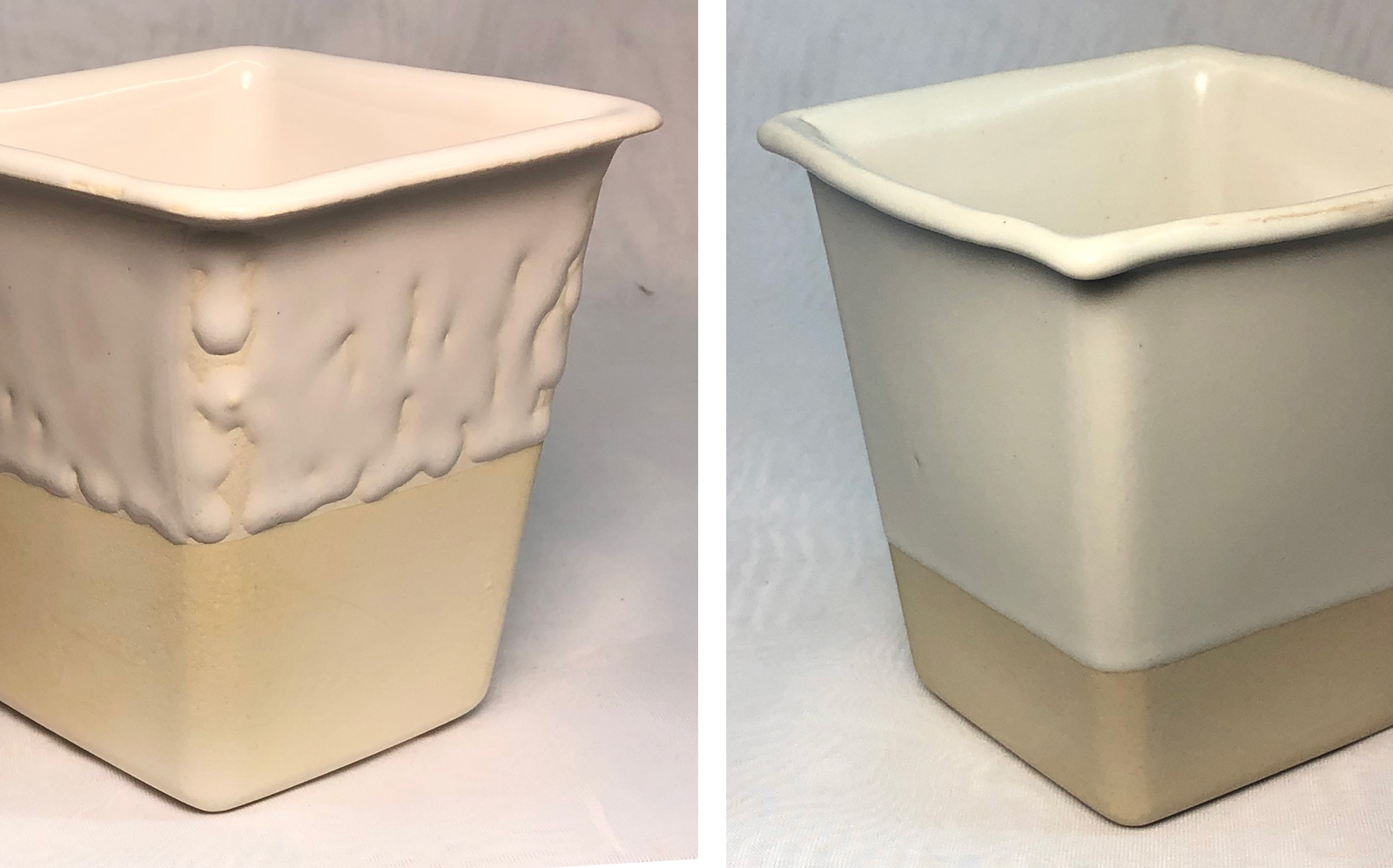
Surface wrinkling of G1214Z pottery glaze:
Not common. Or is it? Appearances can be deceptive.
The reason for this rather strange-looking wrinkling, experienced by one potter, is not obvious. But I suspected the high clay percentage in the G1214Z matte base glaze recipe (which increases drying shrinkage, thus cracking, leading to crawling). I suspect these wrinkles are actually partially healed crawling cracks. The high-clay glaze shrinks and develops tiny cracks or locally loses its bond with the bisque during drying. During firing, the fluid melt begins to pull away at these fault lines, but then flows enough to heal most of them. What remains are these unusual wrinkles rather than the bare patches normally associated with crawling.
To reduce shrinkage, I supply the kaolin as a mix of raw and calcined. The original recipe called for 37 kaolin; I supplied that with 20 EPK and 15 calcined kaolin (15 is the LOI adjusted amount). For most people, the original 37 raw kaolin version is too high (unless a high solids glaze slurry is thinly applied to porous bisque). If you need to prove this, glaze identical test pieces with all-raw G1214Z and raw/calcined G1214Z1, at the same measured thickness and SG. Before firing, inspect them with a magnifier, not just when they first appear dry, but again 5-15 minutes later (high-clay coatings can continue shrinking after they look dry).

Related Pictures
Crawling glazes withdraw into islands during melting
The cause is almost always obvious upon seeing the recipe

This picture has its own page with more detail, click here to see it.
This problem is almost always caused by glazes shrinking too much during drying and then cracking. Those cracks become the crawl points during firing. Excessive shrinkage is normally a product of too much raw clay in a glaze. Even glazes a marginally high clay can crack if applied too thickly. It is likewise with multi-layer application done without consideration for the specific needs of that process (e.g. failure to use a base coat glaze for the first layer). Multi-layering of glazes rewets the first layer, stressing its bond with the body and pulling it away from the body as it shrinks. Base coat glazes have better adherence. Crawling is quite prevalent in once-fired ware since glaze bonding is more tenuous. And in zircon opacified glazes.
To state again: Glazes contain clay to suspend their slurries. Clay shrinks when it dries. Some shrinkage can be tolerated but when it is excessive, something has to give. As glaze layer thickness increases, it is afforded more and more power to impose its shrinkage on the bond with the body. At some point, that bond will be compromised in places where cracks occur to release the tension. Even if these do not appear on dry ware, bond compromise can still exist.
This serious glaze crawling problem was solved with a simple addition
This picture has its own page with more detail, click here to see it.
This is G2934Y white (with 10% Zircopax). I initially blamed the zircon for the crawling. But, since the slurry had settled somewhat I was able to remove about 15% of the water and replace it with CMC gum solution. The gum addition was not enough to slow down the drying much but it really improved reduced the problem! This likely means that adherence of the dried layer to the smooth bisque was the issue. This being said, there were still a couple of small spots where it crawled. The ultimate solution thus appears to be discovering the percentage of CMC gum and water needed to get the least loss of drying speed and while achieving integrity of glaze coverage. It is best to add the CMC gum as a powder at mixing time and blender mix the slurry thoroughly to be sure that it fully dissolves (watch for a rheology change on aging, that will demonstrate if mixing was thorough enough).
Links
| Recipes |
G1214Z1 - Cone 6 Silky CaO matte base glaze
This glaze was born as a demonstration of how to use chemistry to convert a glossy cone 6 glaze into a matte. |
 PayPal | No tracking, No ads, No paywall, No transient content! Just organized, concise information constantly updated and improved. Was this helpful? Consider supporting me. |
Got a Question?
Buy me a coffee and we can talk 

https://backup.digitalfire.com, All Rights Reserved
Privacy Policy