How much powder is in this jar of ceramic glaze?
Here is how to derive that.
In order to add 0.5% CMC gum to this already-mixed glaze I need to know how much powder is present. Here’s how:
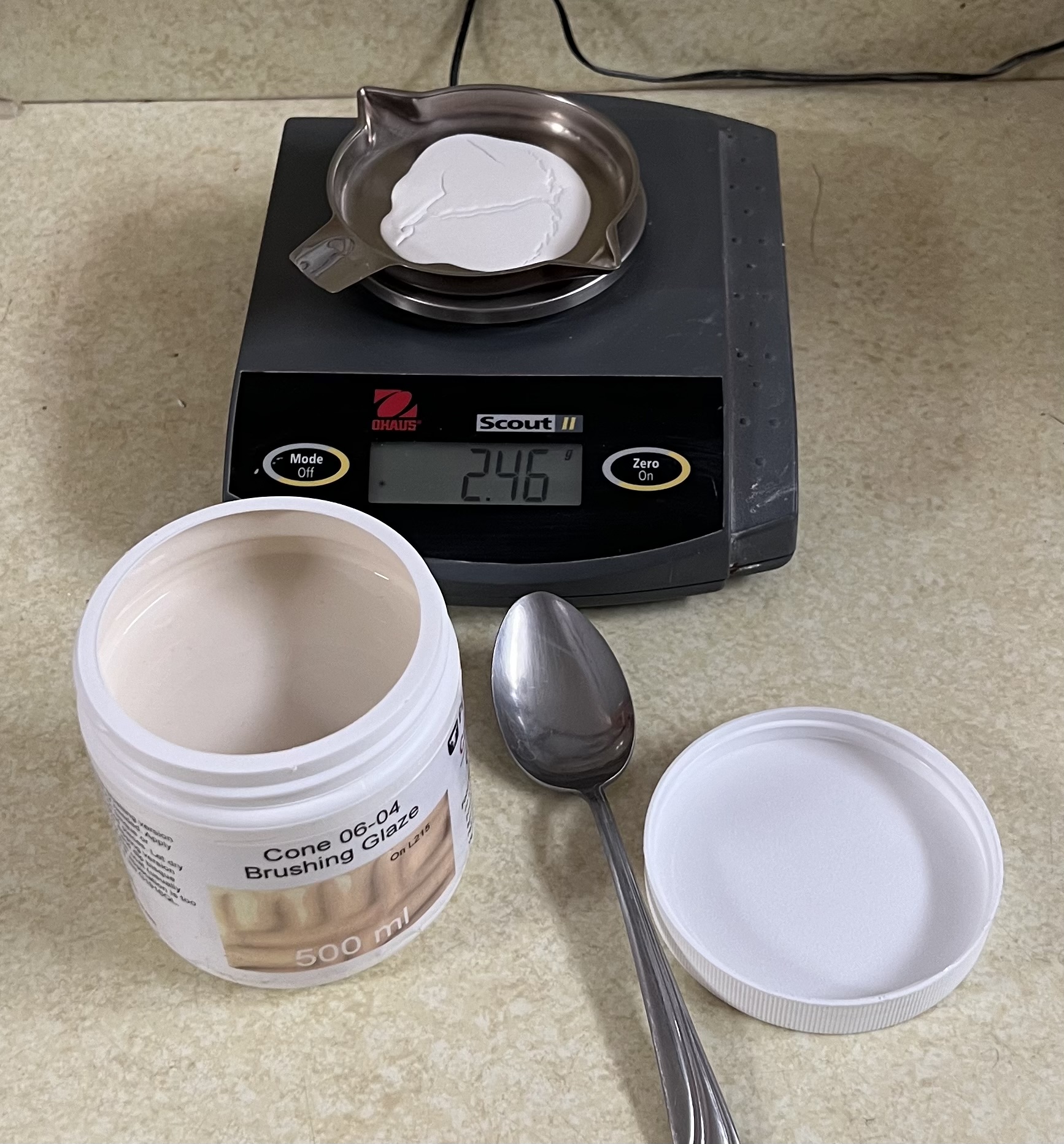
Put a teaspoon of the slurry (well stirred) on the tared-tray of an accurate gram scale. In this case it weighed 5.04g. The tray was just dried under a heat lamp, the scale now reports 2.46g. The water content of the slurry is thus (5.04 - 2.46) / 5.04 * 100 = 51.2% (making the solids content 48.8%). The glaze slurry weighs 645g. 48.8% of that = 315g of powder. 0.5% of 315 = 1.6g of CMC gum to blender mix into this.
Related Pictures
Make your own low SG brushing glaze:
Two ways to do it
This picture has its own page with more detail, click here to see it.
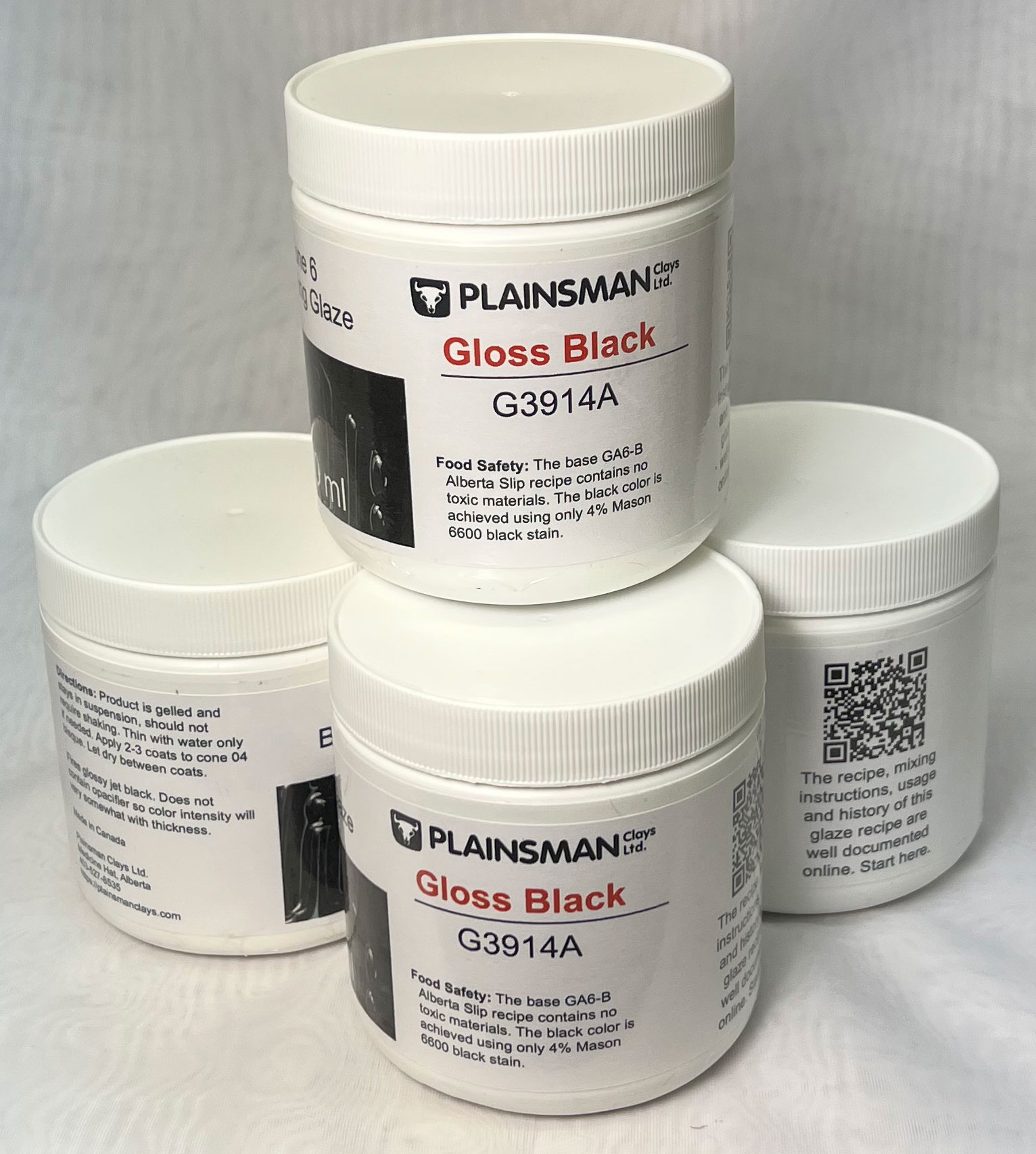
Dipping glaze applies and dries in seconds. Brushing glazes dry slowly and dry hard. Brushing glazes simply have gum in the recipe, dipping glazes typically do not. This is the Alberta Slip cone 6 base with 4% black ceramic stain (code G3914A). Two ways to make a 500ml jar of low SG brushing version:
1) Shake together, in a plastic bag, 340g of mixed glaze powder with 5g of Veegum and 5g of CMC gum. Add that to 440g of water in a kitchen blender and mix on high speed until it gels (up to 60 seconds).
2) Take 680g of dipping glaze (assuming it is about 50:50 water:powder you get 340g of dry), put that in the blender with another 80g of water and proceed as in method 1. During mixing, if it gels too much add the extra 20g of water.
This underglaze is too thin to cover well.
I fixed it in under a minute. Sort of.

This picture has its own page with more detail, click here to see it.
Right: My attempts to apply a layer of watery white underglaze to leather-hard clay. Not surprising that I measured the water content of this at 68%. Yikes!
Left: After adding about a gram of Epsom Salts (and blender-mixing it in to dissolve), the slurry became thixotropic and gelled enough to enable applying a thicker layer with no problem. Note how it stays on the spoon. However, there is still an issue: Multple layers are needed, with lots of drying time between them. The low solids loading of this product also makes it tricky to use on bisque ware (more time is needed between the thinner coats it creates). Allowing it to settle and pouring off water, or evaporating some of the water to raise the specific gravity, would make it even better.
Control gel using Veegum, brushing properties with CMC gum
This picture has its own page with more detail, click here to see it.
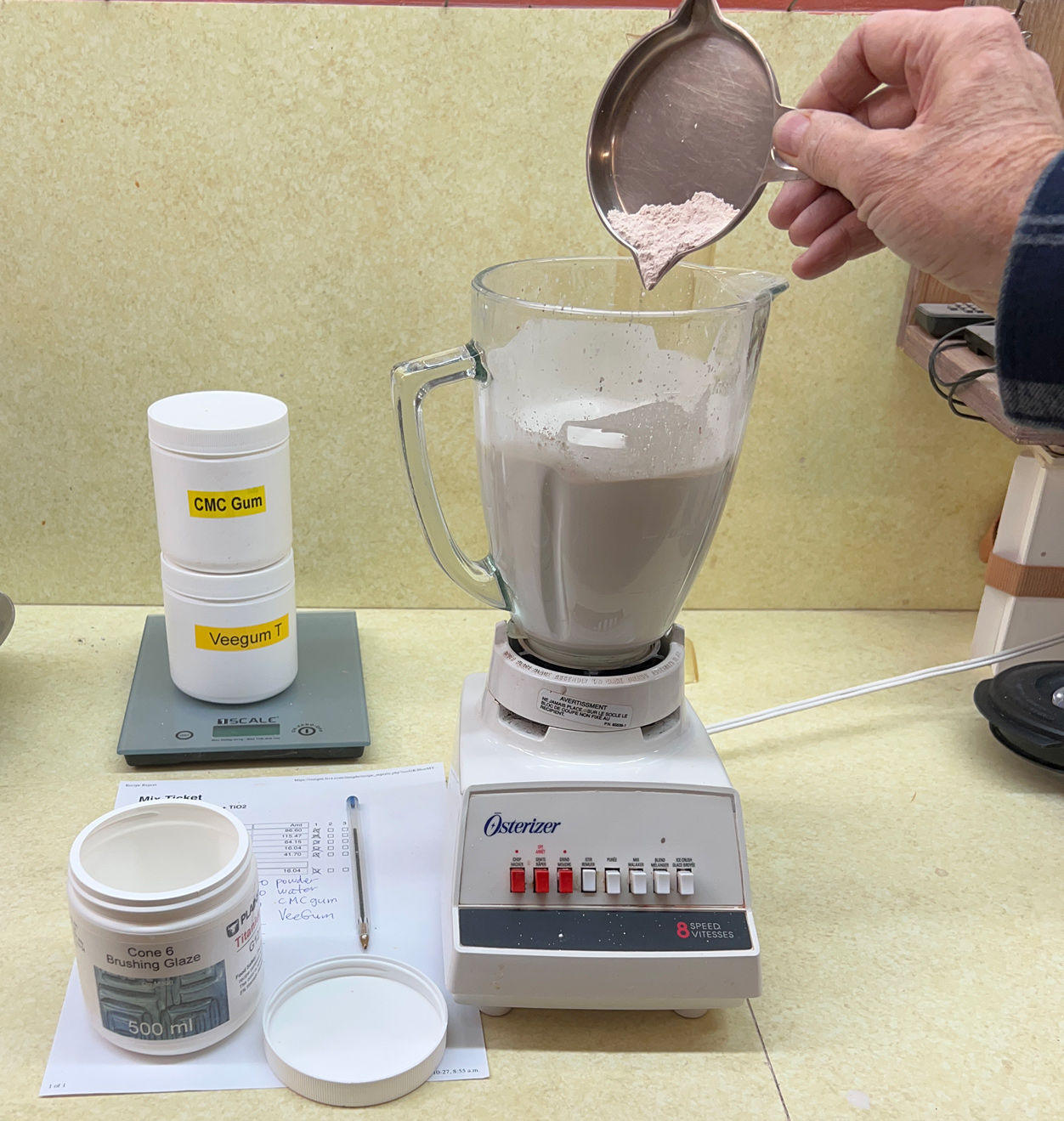
This is G1214Z1 brushing glaze (with 5% titanium added). For a 340g powder batch (to get a pint) my initial target is 5g CMC gum and 5g Veegum. CMC controls drying speed and Veegum the amount of gelling. I first mix the CMC with the powder and shake the whole batch in a plastic bag. Then I add it all to 440g of water in the blender jar and mix it well (making sure no agglomerates remain (stage 1). Stage 2 is adding the VeeGum slowly, while high-speed blender-mixing, this is important because it enables tuning the degree of gel (which cannot be predicted). Because this recipe has little clay, it took all 5g of Veegum without overgelling (the entire mass moved freely in the mixer jar). But it did gel overnight (so 4g would be better next time). By contrast, it is the brushing behavior that demonstrates whether the amount of CMC is right. Not enough and coats dry too fast and go on too thick. Too much and it dries too slowly and too many coats are needed.
Links
| Glossary | Water Content |
| Tests |
LOI/Density/Water Content
LDW LOI, density and water content test procedure for plastic clay bodies and porcelains |
 PayPal | No tracking, No ads, No paywall, No transient content! Just organized, concise information constantly updated and improved. Was this helpful? Consider supporting me. |
Got a Question?
Buy me a coffee and we can talk 

https://backup.digitalfire.com, All Rights Reserved
Privacy Policy