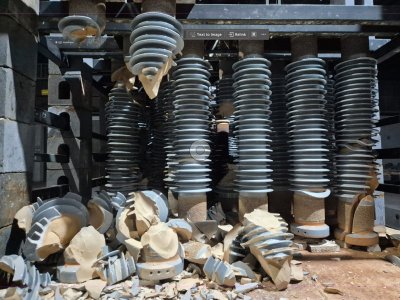
When kilns are not candled long enough
Candling of kilns is the final stage of drying. Driers cannot achieve the temperatures needed to remove all water, so almost all industries rely on early stages of firing to remove it fully. Failures like this are part of the learning curve of every company (because there is always pressure to fire as fast as possible).
Although much more common in heavy clay industries, porcelain insulators are one of the less likely products for this to happen with. This is because machine-forming methods make it possible to use aluminous porcelain bodies having very little clay. Thus, faster drying (with less shrinkage and fewer residual internal stresses) also makes it possible for early stages of firing to be quicker. But there are limits. These insulators are solid, thick and heavy. And they have extreme variations in thickness (thin skirts to solid spindle). So, for even these, early stages of firing must be conducted carefully. For such products, periodic firings of days is often needed.
Related Pictures
This is what happens when a kiln is bisque fired too fast

This picture has its own page with more detail, click here to see it.
In bisque kilns ware is being fired for the first time. If pieces are thick and the rate-of-rise is too fast then water (which is turning to steam) cannot escape fast enough. The internal pressure will fracture a piece like this that has not gone through a thermal drier. The schedule to fire this test brick was 150F/hr to 250 and hold 90, 200F/hr to 1640 no hold, 120F/hr to 1888 no hold. The fracture likely happened because the kiln schedule did not allocate enough hold time at 250°F or proceeded too fast to 1000°F. 250°F might sound like too high a temperature to do water smoking at because it is over boiling point, but in practice it does work in industrial kilns and driers with good airflow (which this kiln does not have).
Links
| Temperatures | Dehydroxylation in kaolin, ball clay (450-650) |
| Temperatures | Pore water removed in clay bodies (80-250) |
| Glossary |
Candling
Refers to the practice of slow-heating a kiln during early stages to give mechanically-bound water a chance to escape. |
| Glossary |
Porcelain Insulators
Among the most difficult ceramic product to make. They demand electrical reliability, mechanical strength, weather resistance, and dimensional consistency over decades of outdoor service. |
| URLs |
https://www.instagram.com/reel/DWYxuxVDzna
Automated porcelain insulator trimming machine at sl-insulator.com.cn |
 PayPal | No tracking, No ads, No paywall, No transient content! Just organized, concise information constantly updated and improved. Was this helpful? Consider supporting me. |
Got a Question?
Buy me a coffee and we can talk 

https://backup.digitalfire.com, All Rights Reserved
Privacy Policy