Candling
Refers to the practice of slow-heating a kiln during early stages to give mechanically-bound water a chance to escape.
Key phrases linking here: candling - Learn more
Details
The practice of slow-firing ware through the critical temperature surrounding the boiling point of water. Although complete drying is usually assumed in almost all firing situations, this is seldom the case. The energy and time requirements to completely dry ware before firing challenge everyone, even large industry where products being fired are heavy, of uneven thickness or made from plastic clays that are very reluctant to let go of inter-particle water. A disastrous kiln-load of exploded product is the experience of everyone having involvement in ceramic production for any length of time. Like it or not, the kiln is the final stage drier in almost all ceramic production.
In pottery, dedicated driers are simply not available. Controlled drying is a makeshift process at best. Candling is thus essential to prevent cracking and explosions associated with steam trying to vent out of ware that is not completely dry. When ware has a thick cross-section, such as for sculptural pieces, a kiln might be candled for days or even a week. For typical gas firings of functional ware, it is common to candle overnight on very low heat and then continue the firing normally the next day.
Most industry fires ware much faster than potters and have found the water-smoking period of a firing can often be conducted much faster than was previously thought possible. Ware can often be heated past the boiling point and soaked there for a shorter time and fired quickly after that. That being said, heavy clay products, especially plastic formed bricks, must be fired carefully during early stages. Sanitary ware, although made from non-plastic clays that vent out water much better, can fail in spectacular fashion if early stages of firing proceed too quickly (especially where pieces are sun dried). Electrical insulators can have even lower clay content and vent water even better, but the extreme thickness differences within a piece and the sheer bulk of solid sections can create “bombs” in kilns fired too quickly or having inadequate ventilation.
Related Information
When kilns are not candled long enough
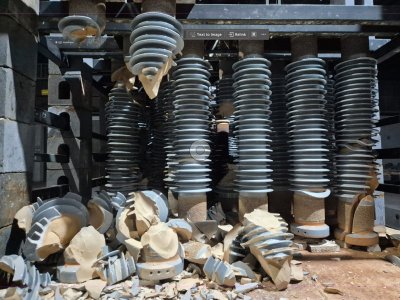
This picture has its own page with more detail, click here to see it.
Candling of kilns is the final stage of drying. Driers cannot achieve the temperatures needed to remove all water, so almost all industries rely on early stages of firing to remove it fully. Failures like this are part of the learning curve of every company (because there is always pressure to fire as fast as possible).
Although much more common in heavy clay industries, porcelain insulators are one of the less likely products for this to happen with. This is because machine-forming methods make it possible to use aluminous porcelain bodies having very little clay. Thus, faster drying (with less shrinkage and fewer residual internal stresses) also makes it possible for early stages of firing to be quicker. But there are limits. These insulators are solid, thick and heavy. And they have extreme variations in thickness (thin skirts to solid spindle). So, for even these, early stages of firing must be conducted carefully. For such products, periodic firings of days is often needed.
Links
| Glossary |
Firing Schedule
Designing a good kiln firing schedule for your ware is a very important, and often overlooked factor for obtained successful firings. |
| Glossary |
Kiln Firing
All types of ceramic are fired in a kiln to cement particles together to produce a hard and water and temperature resistant product. |
 PayPal | No tracking, No ads, No paywall, No transient content! Just organized, concise information constantly updated and improved. Was this helpful? Consider supporting me. |
| By Tony Hansen Follow me on        |  |
Got a Question?
Buy me a coffee and we can talk 

https://backup.digitalfire.com, All Rights Reserved
Privacy Policy