A reason for DIY underglazes:
Glass-bonding with the body instead of just seeking color
This flaking is happening at the interface between the body and orange commercial underglaze (the firing is cone 05). The reason is simple.
Pure stains contribute only one ceramic property: Color! Commercial underglazes sold in jars dilute stains into a recipe of materials, a powder medium, designed to impart the missing properties. However, suppliers like to quote products as suitable over a wide range (e.g. cone 06-6). Of course, at cone 06, they have almost no glass development for bonding to the body and at cone 6 they may well be melted. In this case, the stain used is refractory and a high percentage is needed. So the bond with the body is very poor. A thick layer coupled with an incompatible thermal expansion can make the underglaze/glaze layer pop right off.
Is a DIY version possible? Imagine if you created a powder medium (e.g. L3685Z3) containing enough frit to counter the refractory character of the stain and develop the needed glass to bond with the body. That would solve this problem.

Related Pictures
A reason for DIY underglazes:
Commercial products don't adapt the medium

This picture has its own page with more detail, click here to see it.
All of these commercial underglaze colors. Underglazes are not pure stains; they are a blend of stain powders with a host recipe (a ceramic medium, which is a porcelain-like mix of clay, frit, silica). But the recipe of that medium should be different for each stain type because they have different potencies, effects on rheology and influences on fired maturity. The stain/medium mix is supposed to mature enough to fuse to the body but not so much that it loses opacity, or worse, melts. And the recipe should be different for each temperature!
They all have a powder carrier; that is, they are suspended in a water/gum solution so they brush like paint and dry slowly. Suppliers have got the carrier working great. But the medium is a work in progress! Adapting or optimizing the medium recipe to each color is beyond the ability of most. It is so much easier to use one medium and the same percentage for each stain.
To demonstrate, I fired these...
to cone 8 in a melt flow tester. The blue, green and red are from one manufacturer. The pink/maroon one needs a lot less flux, the blue a little less and the green needs more. The black underglaze (D) has liquefied, gassed out and is about to head down the runway! The E black (a third manufacturer) has not even started to melt or even sinter. The black engobes were plastic; the colored ones were not (likely because a much lower stain percentage is needed).An engobe is shivering off the rim of a low temperature mug

This picture has its own page with more detail, click here to see it.
Classic terra cotta bodies are not vitreous, so engobes used on them need to have similar low-fired shrinkage. But when terra cottas are fired above cone 04 they start to mature and fired shrinkage increases quickly, flaking off engobes that do not have sufficient added frit (to increase their shrinkage). Even if an under-compression engobe can hang on, the extra stresses of an overglaze of lower thermal expansion can compromise the engobe:body bond. That has happened on the center mug. That engobe has less frit (10% vs. 15% for the others). The clear glaze on the left has high thermal expansion and is crazing, while the engobe:body bond can tolerate that it, is obviously not desirable.
Pure stain powders painted overglaze:
Why the bleeding and bubbling?

This picture has its own page with more detail, click here to see it.
The blue is melting and bleeding profusely into the glaze. The green is the opposite - refractory, stiffening the glaze enough to trap bubbles and sit on the surface as a dry, unmelted layer. Under the glaze, these problems would be magnified (the blue bleeding more, the green causing crawling and blistering).
Stains are not ceramic; they are ceramic additives. Stains are not considered safe for direct food contact. Stains are expensive. Stains don't suspend in water, paint poorly and dry as a loose powder.
Both of these (and others) need to be added, as a minor percentage, to a ceramic carrier (one with CMC gum and a mix of ceramic materials tailored to melt to the desired degree and have a compatible chemistry to develop the color (as per manufacturer guidelines).
Make AMACO velvet underglazes work better at cone 04

This picture has its own page with more detail, click here to see it.
Amaco Velvet underglazes fire to a pleasant velvet surface at cone 6 achieving good opacity and coverage. However, at cone 04 the surface is dry. Could the velvet appearance be achieved there? These cone 05 bisque fired Buffstone tiles have a single coat of V-308 Radiant Red topped by a single layer of G1916QL1 clear brushing. Spectrum 700 transparent low-fire glaze has been liquid volume blended at a 9:1, 8:1 and 7:1 (V-308:S700). Notice that as more glaze is added the color actually darkens! By 7:1 the surface is velvety. 8:1 seems optimal (because 7:1 is losing opacity). But caution is needed because the higher the glaze percentage the greater the fired shrinkage misfit between underglaze and body (misfit is not tolerated as well at low temperatures because the bond with body is not as intimate). So a conservative mix 9:1 would be a better starting point. A side-effect is that adding the glaze may change the underglaze’s rheology (so a deflocculant or gelling agent might be needed to establish thixotropy).
Thickly applied slips must fit the body and each other
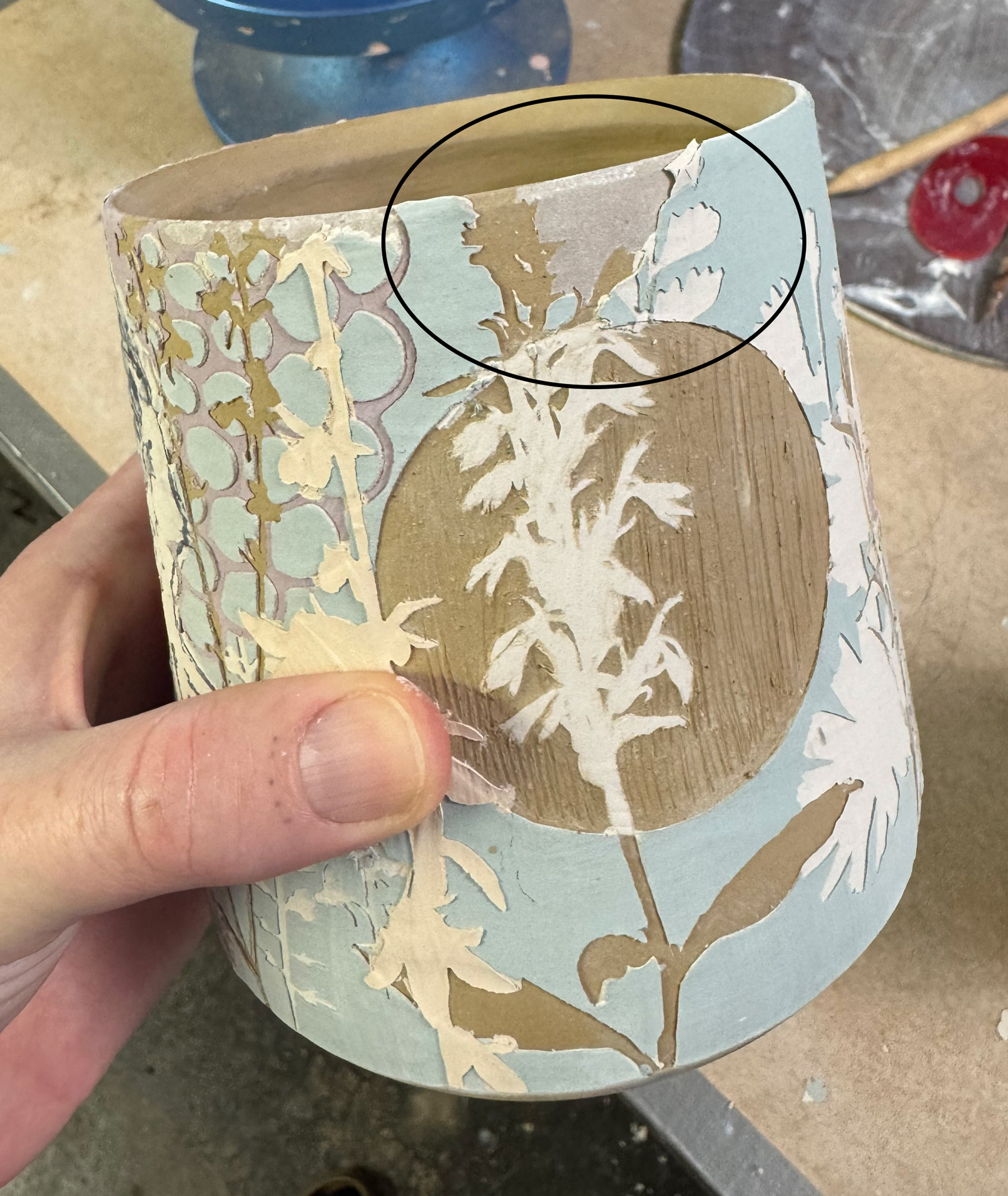
This picture has its own page with more detail, click here to see it.
Fit? It has to stick well. And stay stuck during drying (and shrinking). And the bond has to survive shrinkage that happens during firing. This potter is doing thick applications of each slip (actually that makes them engobes). She uses stains, that's wise, metal oxides bring baggage when used to color slips (e.g. their decomposition can affect the bond, they can gel the slurry, flux the fired product thereby increasing the firing shrinkage of the slip). Stains are better because they affect slurry and fired properties less. But there are still enough issues that each colored slip deserves testing. This potter first slaked B-mix as a slip (it is highly plastic), using it at a runny yogurt consistency. But it bubbled when fired hotter than a cool cone 6. A switch to porcelain slip (which is non-plastic) is shown here. It flaked off as it dried (even in a damp box for 24 hours), also after bisquing to cone 08, and sometimes even after firing to cone 6. This signalled a drying mismatch between body and slip, the bond that managed to survive drying was weakened enough to fail on firing.
The solution was an engobe recipe that is super plastic and sticky. The popular Fish Sauce recipe is an example, it contains 10% bentonite and is unbelievably sticky. L3954B was formulated with this in mind. It adheres well to leather-hard clay and doesn't flake off (misfit is instead evident by surface cracking if its shrinks more than the body). And it is not highly vitreous, keeping its fired shrinkage low enough to match stoneware bodies. Mixing your own recipe also enables compensating the amount of feldspar if the stain affects the slip's degree of vitrification, and therefore fired shrinkage (e.g. blues, oranges, yellows).
Links
| Articles |
Creating a Non-Glaze Ceramic Slip or Engobe
It can be difficult to find an engobe that is drying and firing compatible with your body. It is better to understand, formulate and tune your own slip to your own body, glaze and process. |
| Glossary |
Body glaze Interface
In ceramics, the zone of adherence between glaze to the underlying body is called the clay-glaze interface. The integrity of this interface is important to strength and functionality. |
| Glossary |
Underglaze
Understand pottery underglazes: Why they brush differently, how they fire, why clears fail over them, and how to make your own recipes. In technical rather than art language. |
| Glossary |
Stain Medium
A stain medium (or ceramic medium) is a mix of powdered ceramic materials that impart ceramic properties that stain powders lack in themselves (e.g. ability to form a hard ceramic that fits the underlying body or overlying glaze. |
| Projects |
DIY Underglaze Development
I studied a range of underglazes to understand what they are. Instead, I found out what they should be and how DIY is the key to tuning the degree of fired maturity for my temperature, minimizing costs and tuning the working properties. |
 PayPal | No tracking, No ads, No paywall, No transient content! Just organized, concise information constantly updated and improved. Was this helpful? Consider supporting me. |
Got a Question?
Buy me a coffee and we can talk 

https://backup.digitalfire.com, All Rights Reserved
Privacy Policy