Mason Color
A company open with information
Mason is unusually information-open for the ceramic stain market. Their public reference guide gives compositions by listing oxides such as Co, Cr, Fe, Mn, Ni, Sb, Ti, Zn, Zr, etc., and then marks which oxides are involved in many stain families. It also gives practical compatibility notes, especially about zinc, calcium, firing limits and body-stain use. Their product pages often identify the crystal system/pigment class. For example, Mason 6630 Black is described as a chrome-iron-nickel black spinel formed by high-temperature calcination of chromium, iron and nickel oxides into a spinel matrix. Mason 6274 is described as a nickel silicate green olivine pigment formed from nickel oxide and silica. It is certainly helpful to know if your stain is, for example, a cobalt aluminate spinel, chrome-tin pink, zircon-vanadium blue, nickel silicate/olivine green, rutile yellow, etc. Mason’s technical table also lists CICP/color-index numbers, CAS numbers, chemical names, specific gravity, oil absorption, mesh residue and pH for some pigment lines. Of course, they don't publish oxide percentages, mineralizers, firing schedule, milling procedure, soluble salts, frit additions, trace impurities or batch tolerances. This being said, they are not completely alone; some others also publish such information.
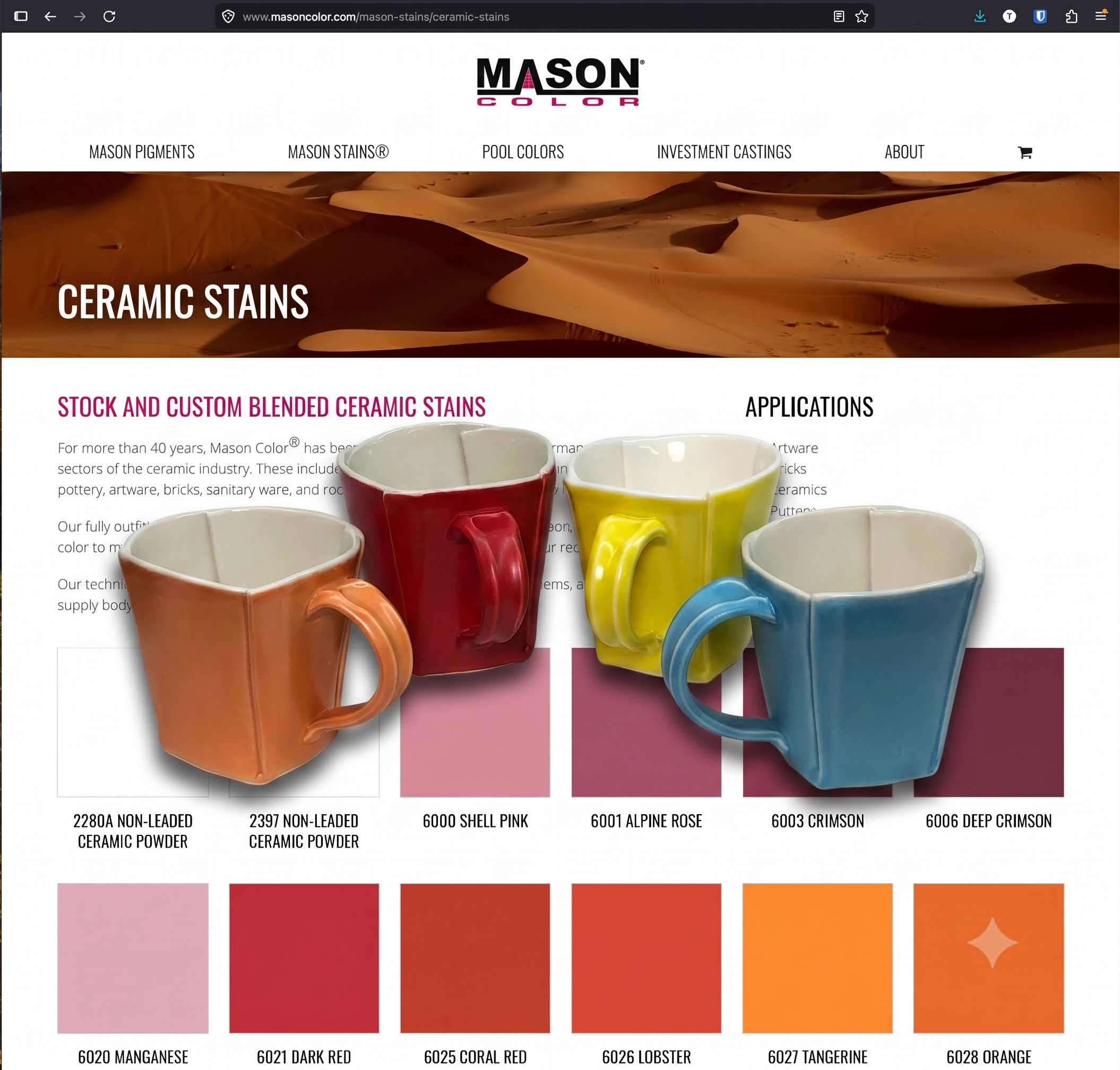
Shown here are mugs I glaze using the G2934Y recipe with added Mason stains.
Related Pictures
Same glaze, same stain percentages
Yet two stains give completely different results
This picture has its own page with more detail, click here to see it.
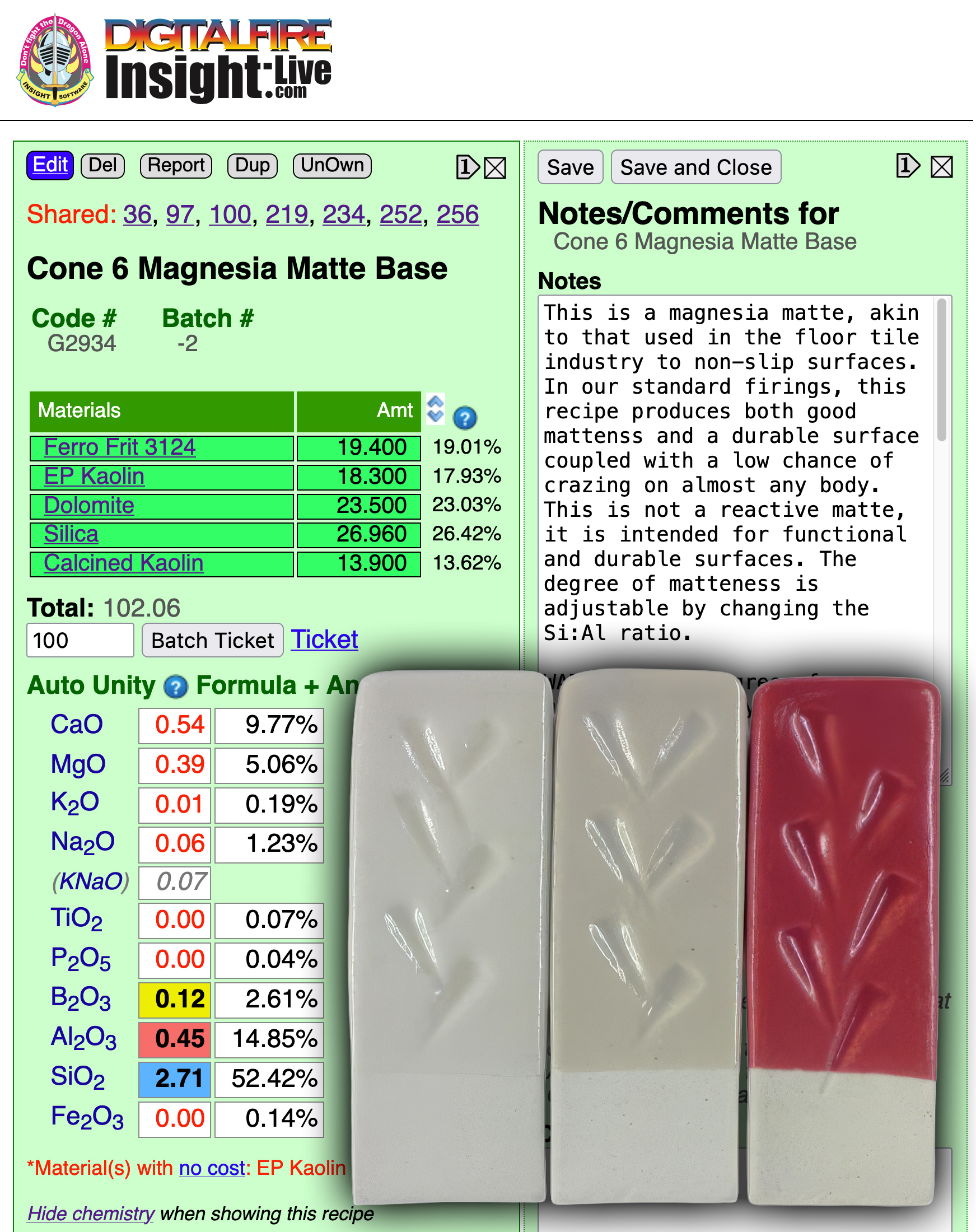
- Left: A cone 6 matte glaze (G2934 with no colorant).
- Middle: 5% Mason 6006 chrome-tin red stain added.
- Right: 5% Mason 6021 encapsulated red stain added.
Why does the red color not develop in the center glaze? This host recipe does not have the needed chemistry to develop the #6006 chrome-tin color (Mason Colors provide glaze unity formula guidelines: 6.7–8.4% CaO and avoiding MgO). This glaze recipe calculates to 9.8% CaO and 5% MgO. The MgO is the likely reason the red fails to develop. Yet this glaze produces excellent color with #6021 encapsulated stain (right). It isn't automatic that a strong red is achieved at just 5% encapsulated stain. The color is embedded in zircon crystals and aggressively melting KNaO, which this base recipe has very little of, attacks them and reduces color intensity.
Links
| URLs |
|
| Glossary |
Ceramic Stain
Ceramic stains are engineered crystalline pigment powders. They are used as an alternative to employing metal oxide and have many advantages. |
 PayPal | No tracking, No ads, No paywall, No transient content! Just organized, concise information constantly updated and improved. Was this helpful? Consider supporting me. |
Got a Question?
Buy me a coffee and we can talk 

https://backup.digitalfire.com, All Rights Reserved
Privacy Policy