Stain Medium
A stain medium (or ceramic medium) is a mix of powdered ceramic materials that impart ceramic properties that stain powders lack in themselves (e.g. ability to form a hard ceramic that fits the underlying body or overlying glaze.
Key phrases linking here: ceramic medium, powder medium, stain medium - Learn more
Details
Ceramic stains are manufactured by calcining combinations of metal oxides to form stable crystalline structures. Compared with many raw oxide and carbonate colorants, they normally contribute little firing gas and produce more predictable colors. Most are refractory and are not intended to form a durable fired coating by themselves. Stains differ greatly in melting behaviour, particle size, opacity, host-glaze requirements and color strength. Increasing the percentage often produces a reasonably predictable increase in color (within the useful range).
A ceramic decorating product can be considered as three components: Ceramic stain + ceramic medium + powder carrier
- The stain supplies the color.
- The ceramic medium is the non-color mineral formulation that hosts the stain. It remains after firing and gives the decoration its ceramic properties: adhesion, melting behaviour, opacity, surface character, hardness and thermal expansion.
- The powder carrier is the liquid and additives that make the stain and ceramic medium brushable, stampable, screen-printable or otherwise applicable. Most of it burns away during firing.
Photo not found
or not published
In a colored glaze, the glaze recipe itself is the ceramic medium. Its SiO2, Al2O3 and flux chemistry determine when and how much it melts, whether the surface is glossy or matte and whether its thermal expansion fits the body. In many glazes, 1–10% stain develops adequate color without requiring a compensating recipe change. Where higher percentages are required the stain can affect melt fluidity, opacity, surface character and thermal expansion.
An engobe or underglaze has a ceramic medium. It normally contains clay to provide suspension, drying strength, shrinkage compatibility and adhesion to unfired ware. It also contains enough frit, feldspar or other flux-bearing material to develop enough glass for a fired bond. When enough glass is needed to compromise opacity, zircon is added. Underglazes and engobes require much more stain than transparent glazes that intensify color in a transparent glass. Still, a powerful cobalt blue or black might need only a small addition, while some yellows, oranges and encapsulated colors require much more.
A ceramic ink is defined more by its application method than by its fired composition. It may be formulated for screen printing, stamping, inkjet printing, pen application, lining or transfer printing. A durable ink normally contains: stain + a fluxing or sintering ceramic medium + a suitable printing vehicle
An ink containing stain and vehicle alone may work when it is trapped beneath a glaze or when the pigment bonds adequately to the surface. But a free-standing decoration generally needs some frit or other ceramic bonding material. Too little produces a weak or powdery fired image. Too much can cause spreading, blurred detail, unwanted gloss, excessive melting or a mismatch in thermal expansion.
Veegum is a special case. It is not an organic gum but a refined magnesium-aluminum-silicate smectite clay. It acts as a suspending agent, binder and rheology modifier and leaves a small mineral residue after firing. It therefore contributes to both working properties and, slightly, to the ceramic formulation.
Water-based inks can be screened directly onto absorbent leather-hard, dry or bisque ware. Oil- or solvent-based vehicles are useful when printing onto less absorbent surfaces or when the printed line must resist a subsequently applied water-based glaze. Cuerda seca intentionally uses an oily or waxy line to separate glaze areas.
Transfer methods also need to be distinguished. A newsprint or tissue-paper transfer requires an ink that remains attached to the paper during printing but releases onto damp clay. A waterslide ceramic decal is a different system: the printed decoration is supported by a covercoat and slides from a specially coated paper after the release layer is wetted.
For rubber stamping, ceramic powder can be mixed with enough glycerine to form a thick printing paste. The glycerine makes the powder rollable, slows drying and keeps it workable on the stamp. It does not, however, supply fired adhesion. The powder being stamped must either contain a suitable ceramic medium or subsequently be covered by a glaze that bonds and protects it.
The cost and performance of commercial underglazes sometimes motivate potters to develop their own. A product may be too refractory or too fluid at the intended firing temperature, may not accept an overglaze well, may brush poorly or may be unsuitable for screen printing. A DIY approach enables the three variables to be developed separately. First, tune the ceramic medium for adhesion, opacity, melting and compatibility with the body and firing temperature. Second, adjust the stain percentage for the required color. Finally, tune the powder carrier for the intended method of application, adjusting specific gravity, viscosity, yield value, drying rate, wetting and dry hardness.
Keeping these three components separate makes troubleshooting much easier. Fired problems normally point to the stain or ceramic medium; brushing, settling, drying and printing problems normally point to the powder carrier.
Related Information
Pure stain powders painted overglaze:
Why the bleeding and bubbling?

This picture has its own page with more detail, click here to see it.
The blue is melting and bleeding profusely into the glaze. The green is the opposite - refractory, stiffening the glaze enough to trap bubbles and sit on the surface as a dry, unmelted layer. Under the glaze, these problems would be magnified (the blue bleeding more, the green causing crawling and blistering).
Stains are not ceramic; they are ceramic additives. Stains are not considered safe for direct food contact. Stains are expensive. Stains don't suspend in water, paint poorly and dry as a loose powder.
Both of these (and others) need to be added, as a minor percentage, to a ceramic carrier (one with CMC gum and a mix of ceramic materials tailored to melt to the desired degree and have a compatible chemistry to develop the color (as per manufacturer guidelines).
Pure stain powders painted under the glaze:
Why is the glaze shedding off?
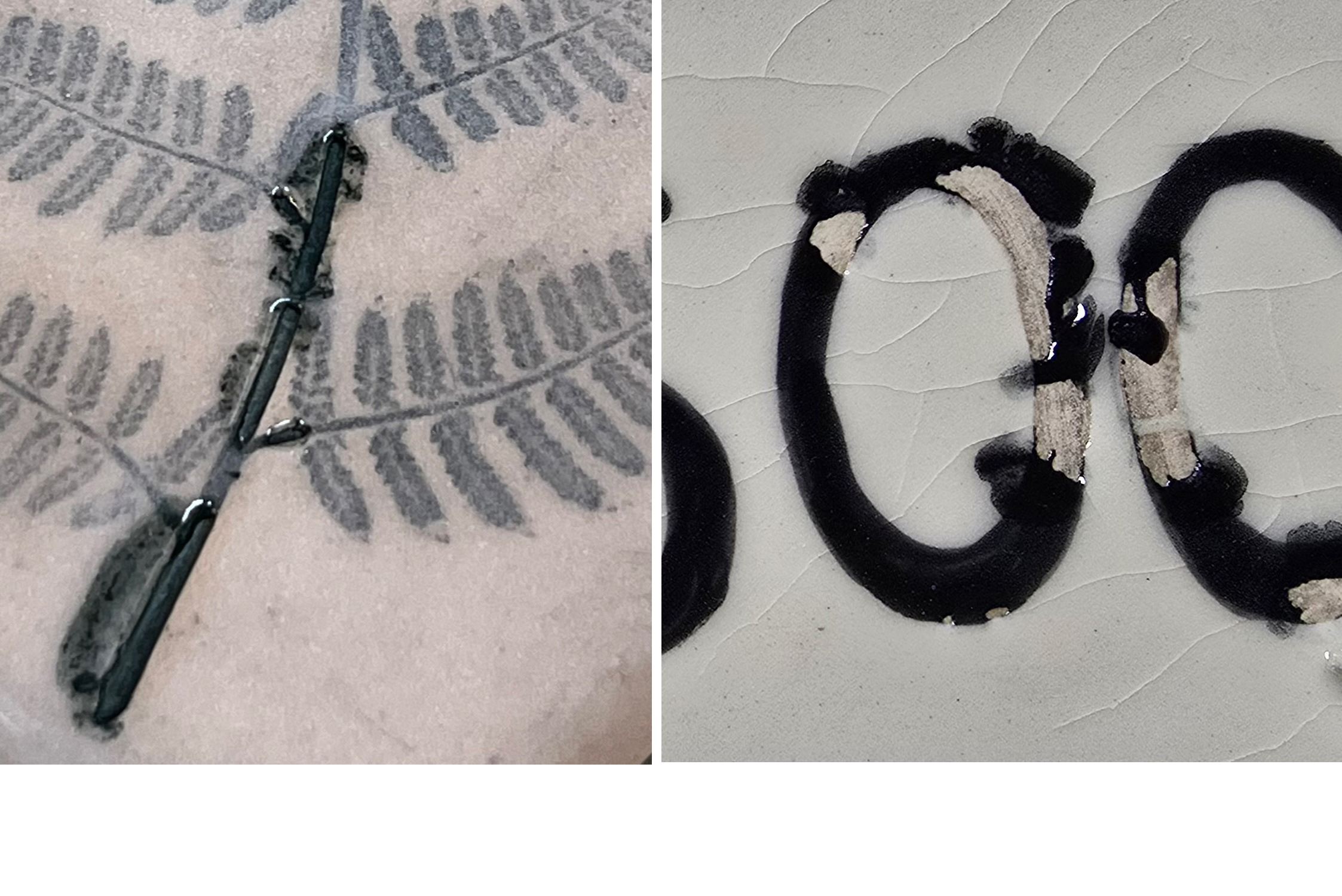
This picture has its own page with more detail, click here to see it.
These black stain-water mixes were painted onto bisque and an overglaze was applied. Out the kiln, this crawling happened. Why? Many stains are refractory, thus do not glass-bond with the body. And they repel being wetted by the molten glaze on top. Stains need to be mixed with a stain medium that both supplies a bonding glass (for firing) and a clay to suspend the slurry and dry-harden and dry-bond it. One medium option used to be Gerstley Borate, it was both plastic (so it dried like a clay and suspended the slurry), and it was a melter. It was just a matter of tuning the percentage to optimize performance. One problem was that the best mix of those ended up using 70% stain (whereas 15-20% is theoretically enough). A better option is to use a full-fledged medium, a recipe. Each of the ingredients is there for a purpose. This provides the ultimate flexibility to tune the mix properties for brushing and firing (also enabling minimizing the percentage of stain).
Pure stain rubber-stamped under the glaze:
This one is too potent to use pure.

This picture has its own page with more detail, click here to see it.
The logo on the left was rubber-stamped using an ink mix made of Mason 6666 black stain in a glycerine carrier. During firing, the glaze is shedding off. The stain is refractory yet still bleeding excessively into the overlying glaze. Further, it does not melt during firing, so it does not glass-bond with the body below. And, it either develops only a fragile interface with the glaze above, or sheds it off.
The piece on the right mixes the stain 50:50 with a glossy transparent glaze; from that it stamps better, inherits better lay down, accepts the overglaze better, and dries harder.
A Clear Glaze Bubbles Over DIY Underglazes:
The real solution is in the underglaze recipe
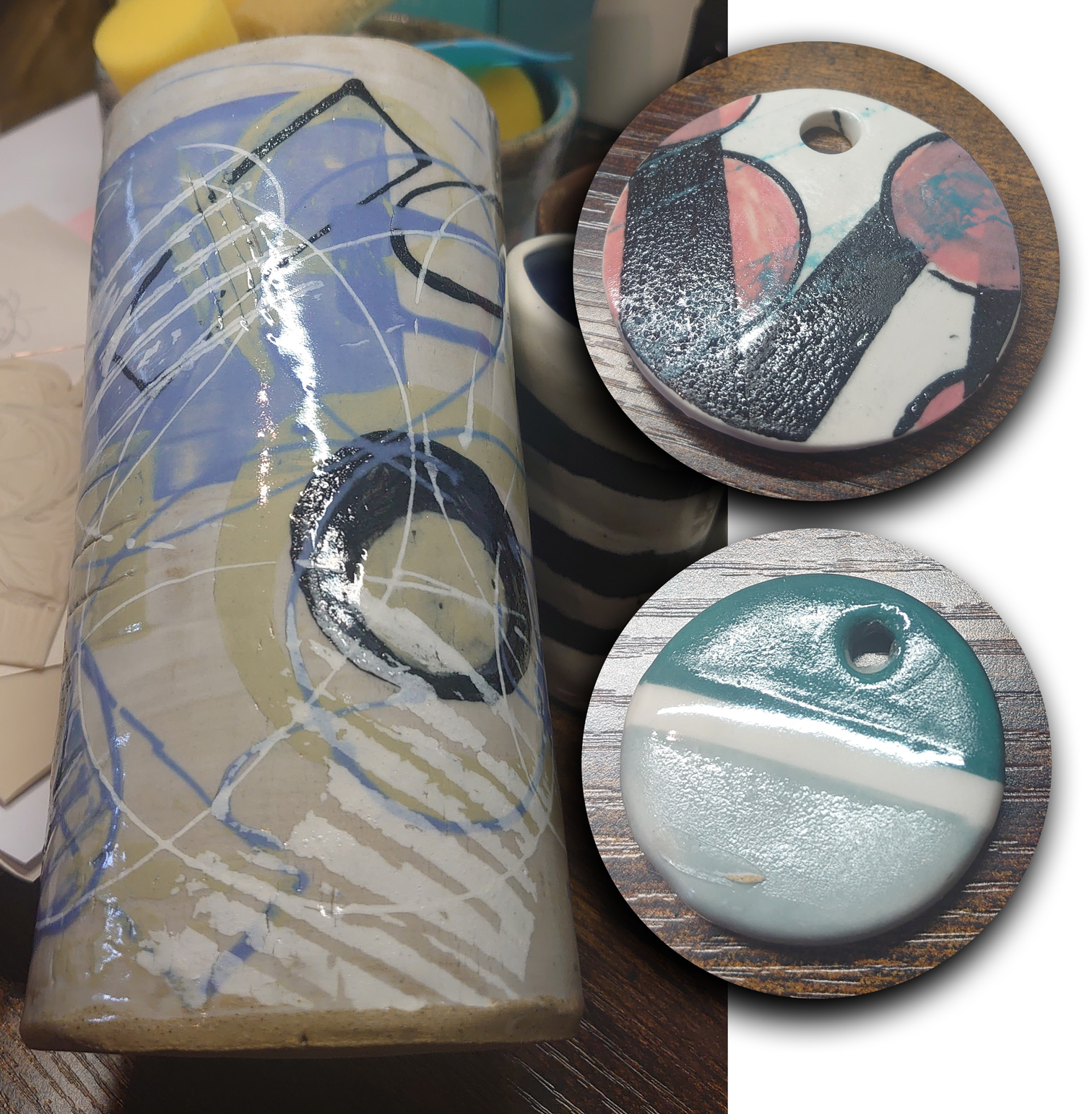
This picture has its own page with more detail, click here to see it.
Potters often encounter the problem shown here. These pieces are fired at cone 6. They are decorated with underglazes made from a mix of porcelain powders and stains. The transparent glaze works over certain colors but on others, it is full of microbubbles and pinholes. The potter has not had success finding a transparent overglaze that works consistently. Stain manufacturers do not mix stains with porcelain to making underglazes.
So, although closer control of the transparent glaze thickness or a more fluid melt glaze recipe might help, the real solution may lie with the underglaze recipes used here. An ideal bisque-stage underglaze is sinter-bonded but not sealed (therefore not accepting glaze water). An ideal fired underglaze also has controlled maturity: enough glass development to bond well to the body and promote glaze acceptance, but not so much that edge-bleeding and opacity loss occur. This state of 'controlled maturity' is also more likely to match body thermal expansion. The cost savings and the potential to fine-tune each color to your exact needs can be powerful motivations to use DIY underglazes.
A reason for DIY underglazes:
Glass-bonding with the body instead of just seeking color

This picture has its own page with more detail, click here to see it.
This flaking is happening at the interface between the body and orange commercial underglaze (the firing is cone 05). The reason is simple.
Pure stains contribute only one ceramic property: Color! Commercial underglazes sold in jars dilute stains into a recipe of materials, a powder medium, designed to impart the missing properties. However, suppliers like to quote products as suitable over a wide range (e.g. cone 06-6). Of course, at cone 06, they have almost no glass development for bonding to the body and at cone 6 they may well be melted. In this case, the stain used is refractory and a high percentage is needed. So the bond with the body is very poor. A thick layer coupled with an incompatible thermal expansion can make the underglaze/glaze layer pop right off.
Is a DIY version possible? Imagine if you created a powder medium (e.g. L3685Z3) containing enough frit to counter the refractory character of the stain and develop the needed glass to bond with the body. That would solve this problem.
Faux majolica next level: Stoneware!
But the glaze is crawling under the colors.
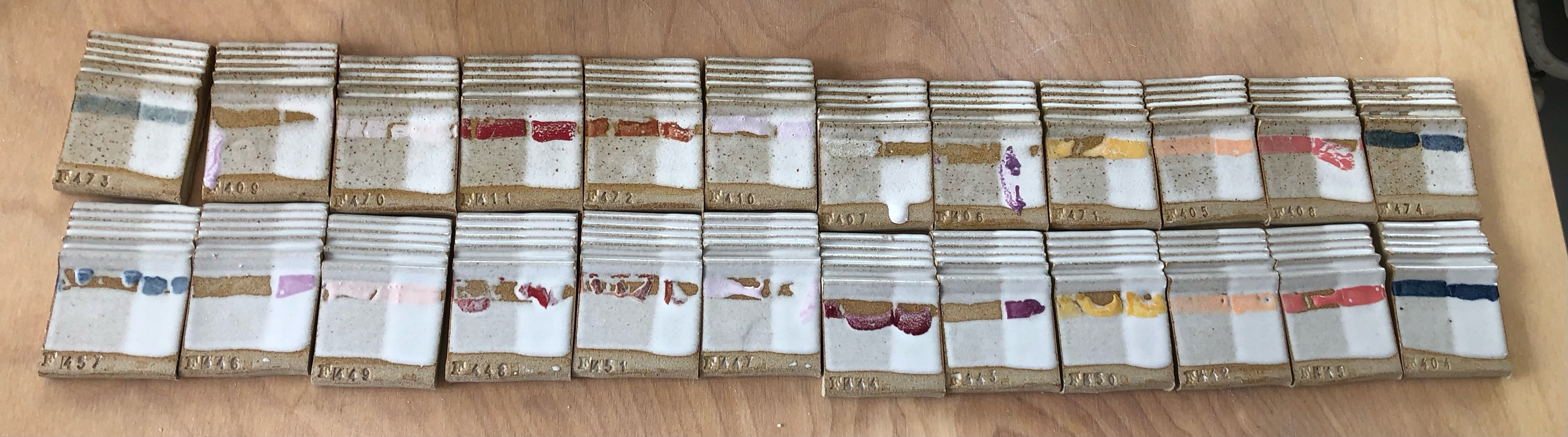
This picture has its own page with more detail, click here to see it.
The original Italian majolica ware was red earthenware with a thick layer of tin-opacified glaze vibrantly brush-decorated using single-strokes of watery metal oxides. The water-color of ceramics. But tin oxide is no longer affordable. And ceramic stains are better. And no one uses lead glazes. So all majolica-like ware made today is actually “faux (false) majolica”. These test samples take the “faux” to the next level: Stoneware with a zircon-opacified white glaze. But almost all are crawling. If this happens for you ask these questions:
Is the glaze re-wetable? Dipping glaze recipes often are not, especially if they fail sanity check (e.g. are over-clayed or under-clayed).
Base coat dipping glaze better survive the rewetting of a second layer?
Mixing them as a brushing glaze give maximum insurance.
What did they look like when the overcolor dried? Cracks are sure indicator or crawling.
Were you painting pure stain or metal oxide (mixing with water only)? Don’t do that. Water color paint uses gum Arabic, pottery colors need to be in a stain medium (which often has CMC gum).
Silk screen medium mixing to tune properties

This picture has its own page with more detail, click here to see it.
One well-known artist blends these two types, permanent and washable, with a powdered ceramic pigment, in the proportions appropriate to get as much hardness as possible but not so much that it is difficult to clean up the screen.
The powder should not be a pure ceramic stain; it should be a mix (or powder carrier). Powder carriers are a recipe of materials having a melter medium so it fires to an adequate degree to bond to the body and form a durable ceramic, and have a similar thermal expansion to the body. The ceramic stain is added to that, in only the percentage needed to achieve the desired color intensity.
Inbound Photo Links
 How can underglaze and engobe colors be this bright? |
Links
| Glossary |
Powder Carrier
A powder carrier is the liquid vehicle that enables a ceramic powder mixture to be brushed, sprayed, poured, printed or otherwise applied. |
| Glossary |
Encapsulated Stain
This is a type of stain manufacture that enables the use of metal oxides (like cadmium) under temperature conditions in which they would normally fail. |
| Glossary |
Ceramic Stain
Ceramic stains are engineered crystalline pigment powders. They are used as an alternative to employing metal oxide and have many advantages. |
 PayPal | No tracking, No ads, No paywall, No transient content! Just organized, concise information constantly updated and improved. Was this helpful? Consider supporting me. |
| By Tony Hansen Follow me on        |  |
Got a Question?
Buy me a coffee and we can talk 

https://backup.digitalfire.com, All Rights Reserved
Privacy Policy