A.I. in Ceramics
Unbelievable things are happening. Good and bad. A.I. Is polarizing and revolutionizing ceramics. For us at Digitalfire, perhaps the biggest benefit is more enablement of DIY.
Key phrases linking here: a.i. in ceramics - Learn more
Details
This is huge. And it exploded into the mainstream in 2024 and changed the world in 2025. Industry figures are campaigning for trillions of dollars to build dozens of chip factories and hundreds of data centers (and the massive electrical infrastructure these will require). One goal is to create AGI (artificial general intelligence) - the degree to which that can be taken seems limitless. Some call it the most complex and ambitious task in the history of humanity. Strangely, A.I. is turning out to be especially good at creativity and the liberal arts. Works made using it are even copyrightable. But only sometimes great on technical matters (see examples below about how dead wrong it is about some things). While so-called "Prompt Engineering" is emerging as a new science of learning how to interact with AI to get the best possible results, it likely won't last long, newer models don't need it and we will all learn it as part of our jobs and lives.
Ethical questions also abound here. Unfortunately, humankind is riding this horse of A.I., and we don't really know where it is going! Many have inaccurate and uninformed opinions about how it works, whether it is real and to what extent it is already touching their everyday lives. Pretty much everyone is likely underestimating A.I. We know for sure that it is not going to get dumber; it is only ever going to get smarter. The unstoppable tidal wave going mainstream is math, and it is out of the bag. There is no stopping or regulating it. People who use A.I. do it such that we don't know. Or they might not even know. It will edge its way into our lives from all sides.
At first, few people were talking about the computing power needed; we now realize it is far greater than what crypto-mining took. Many trillions of dollars of investment. nVidia is riding the AI wave like no one else, they have become the world's largest company. But their position is precarious; they must reduce power consumption ten-fold each year or someone else will take over. If this follows the patterns of the past, the industry will over-build and the cost per/token will fall to almost nothing. We will all have "token budgets".
People who feel that AI is just a plagiarism machine may base this on the belief that it is not actually learning, it is either just copying or is a word-prediction system. However, a fundamental aspect of modern AI (as opposed to old-style expert systems) is that it does learn. Modern AI is far beyond just generating words and simulating intelligence. It is making music, art, photos, video and movies, writing poetry, and so much more. It is better at humans than recognizing what is in photos, compared real or generated photos. Sentiment-analysis abilities are beyond most humans. The IT industry has now quantified intelligence and can sell it in units. In 2025, consider that a $40 Raspberry Pi microcontroller can be put through school and medical school for $20, and score better on the HealthBench test than most doctors. A video conferencing help-desk worker can now be replaced by A.I. for $200/year.
Although many object to the use of AI as a creative tool, the mountain that most of us struggle to climb is making a website. AI tools can do that completely automatically now. This kind of creativity seems helpful, doing something that pretty well none of us enjoy. And it is fast. And the results are better than 95% of the sites that artists and potters make (or have made) to promote their work. Maybe this is one place where we could tolerate its use, let it start and we can perfect it.
ChatBots (and soon virtual employees) are like having constant access to PhD-level knowledge on every conceivable endeavor. Human experience and perception are the perfect recipe to harness the power of A.I. Consider it like a new graduate with little practical experience. Or, compare it with how a lawyer can help you. He/she explains what your options and risks are, what you might be overlooking or forgetting, what things you need to double check, what things you might be misunderstanding. It is advice that enables better decisions and path choices.
Related Information
These pots are not real.
In 2023 that seemed impossible
 Created, as explained, at MidJourney.com (to demonstrate the state of text-to-picture in 2023) AI Policy
This picture has its own page with more detail, click here to see it.
I created these images using the "imagine" command at MidJourney.com. To was jaw-dropping at the time - I thought AI was just plagiarizing but it really did appear to be learning. Top left: I asked for "stoneware pottery mugs with floral decoration covered by a glossy transparent glaze". For the vase: "Crazed transparent glaze over floral decoration". How does it know what crazing is? Notice the things I forgot to specify for the porcelain mugs: Handmade, one handle, decoration should only be on the outside and handles are not decorated (an indication that AI had not learned that yet). For the last one, I asked for a piece demonstrating the difference in runniness of two different glazes. How did it know what runny glazes are? How did it know a bowl would be the best shape to demonstrate the latter? These observations and the fact that it can generate very high-resolution images seem to indicate it is actually drawing the pieces, not just showing photos it found online.
This impossible AI porcelain mug:
Is it actually learning?
 Pictures generated at MidJourney.com to demonstrate to state of text-to-picture in 2024 AI Policy
This picture has its own page with more detail, click here to see it.
Consider these porcelain mugs I "imagined" at MidJourney.com (in early 2024). At first, they looked pretty typical, a closer look at the one in the middle reveals a something strange: A floral design on the one behind morphs into the actual 3D shape on the one in front. This seems like an indication that the AI is actually drawing these, not just plagiarizing them from its scraping activities online. The #aiart, #aiartwork, #aiartcommunity and similar hashtags generated millions of posts (albeit of questionable taste), but they were a harbinger of things to come.
ChatGPT was completely wrong about the cause of glaze crazing in 2023!

This picture has its own page with more detail, click here to see it.
ChatGPT was parroting common wrong suggestions about the cause and solution of the serious issue of crazing. Yet it trained on thousands of internet pages about the subject! Crazed functional ware is defective, and customers will return it. So fixing the problem is serious business, we need correct answers. Consider its suggestions: #1 is wrong. There is no such thing as an "incompatible mix" of ceramic materials. Crazing is an incompatibility in thermal expansions of glaze and body, almost always a result of excessive levels of high-expansion K2O and Na2O in the chemistry of the glaze. The solution is reducing them in favor of other fluxes (the amount per the degree of COE mismatch). #2 is wrong, firing changes don't fix the incompatibility of thermal expansions. #3 is wrong, refiring makes the crazing go away but not the stress of the mismatch, it will for sure return. #4 is completely wrong. Firing higher takes more quartz grains into solution in the melt and should reduce the COE (and mature the body more which often improves fit). And melt fluidity has nothing to do with crazing. Furthermore, if a glaze does not run off the ware, it is not overfired. Of course, this is the worst it will ever be, expect better in future.
ChatGPT has an opinion about making my frits:
But it missed a key factor this picture demonstrates

This picture has its own page with more detail, click here to see it.
Here is part of a ChatGPT answer that seems to confirm what I have observed in smelting material mixtures into ingots in my alumina-lined and zircon-lined slip-cast test crucibles. The upper one was fired at cone 4, the lower one at cone 6. Notice how the higher temperature has really helped to debubble the melt and produce a better glass. But it is still not melting to a transparent glass. This indicates that these small test batches are not fully reacted (all particles completely dissolved into the melt).
The upper picture reveals a potentially serious issue with making frits in a crucible: Frothing. When LOI gas evolution overlaps with the formation of a sticky melt, the batch can swell into foam. That foam impedes heat transfer, and the viscous melt can retain the bubbles. That being said, gas bubbles generated during melting can assist mixing as they rise through the glass. So it is a balance: Bubbles yes, foam no. Crucible capacity must accommodate the batch during reaction—not just the finished ingot. In industry, they use the term "generous crucible headspace and suitable refractory secondary containment" to refer to learning how much to fill to avoid overflow and how to mitigate this when it does happen. In a frit batch containing significant carbonates and hydrates, it could be that even a half-full crucible could overflow!
ChatGPT is surprisingly wrong about the causes of glaze crawling.

This picture has its own page with more detail, click here to see it.
ChatGPT trained on the entire internet and yet gave 100% wrong answers and neglected the key thing that causes 90% of crawling! How can the internet be so wrong? Consider the suggestions it gave:
-Dust or oil on the bisque: This almost never happens. Besides, glaze is a mix of dust and water!
-Too much feldspar in a glaze can cause it to shrink excessively during firing: No, high feldspar causes thermal expansion/contraction of the fired glass, not physical shrinkage of the melt.
-If the clay body surface is not roughened, the glaze may not adhere properly: No, glazes don’t crawl any more on porcelains than other bodies.
-If the glaze is too thick in some areas and too thin in others, it can crawl in the thin areas: No, it crawls where thick because that’s where it cracks during drying.
-Over-firing or under-firing: No. Glazes fired to the ideal temperature crawl just as much.
-If the pottery is dried evenly or the drying process is too rapid: No, rapid drying of glaze on bisque is important to prevent cracking.
This crawling happened because the glaze cracked along the inside of that corner during drying. Such cracking is by far the number one cause of crawling, the melt pulls back from either side of the crack. The specific gravity of the slurry was too high, the resulting greater thickness right at the corner gave the shrinking glaze power to pull a crack. Adding water to bring the SG back down to 1.4 and then Epsom salts to gel it to thixotropic gave the slurry much better dipping and drying properties and totally solved this issue.
An entire website created with a one-sentence request

This picture has its own page with more detail, click here to see it.
This was made at 10web.io, in 2024. I simply wrote it a couple of sentences describing a website that explores the connections between ceramics and fashion and one that could be used to promote the making of garments having ceramic elements. In about a minute it generated this! It is pretty weird, but a great starting point. It is built on top of WordPress so I get the normal dashboard with all the authoring tools (and optional add-ons). None of these people exist! Or things. This site adapts to phones, tablets or PCs. And it is fast.
Over the next two years, AI site and page generation became standard features everywhere. I also make sites at ZipWP.com, back them up using All-in-one Exporter, and restore to a free server.
Another pottery website generated entirely by AI

This picture has its own page with more detail, click here to see it.
This was made at 10web.io. I simply wrote it a couple of sentences describing a website that sells pottery mugs made to celebrate that special pet dog. It is built on top of WordPress so I also get the normal dashboard with all the authoring tools (and optional add-ons). Neither this business or any of these dogs or people exist! But the idea exists in my mind and the AI is a starting point to making it real.
Two ChatBots square off on crazing in 2025
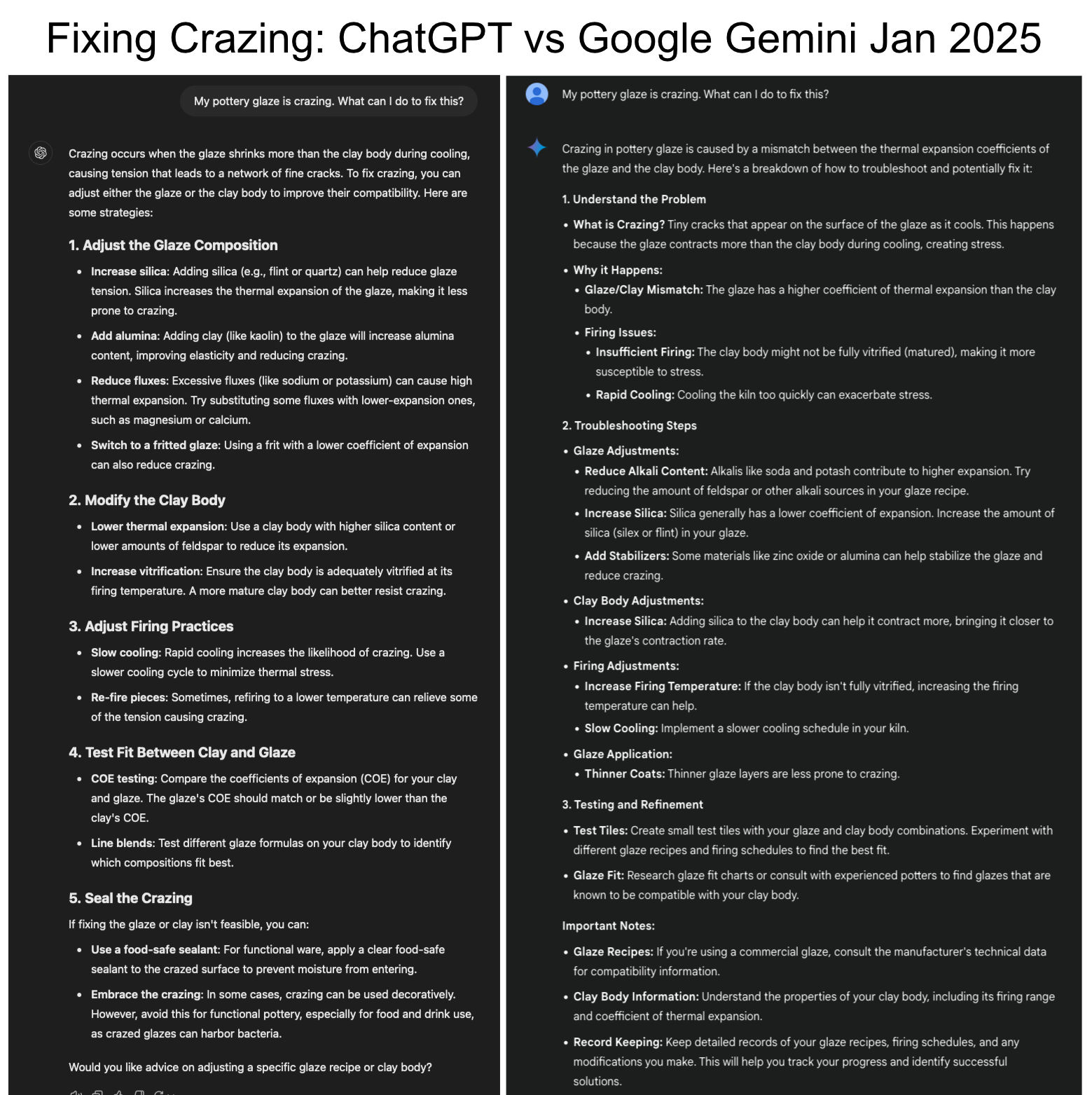
This picture has its own page with more detail, click here to see it.
In 2025 ChatGPT’s four glaze adjustment suggestions are either wrong or will accidentally fix crazing because they address other issues that just happen to also be present. Adding enough silica or alumina brings unacceptable side effects on multiple fronts. Alkali fluxes need to be substituted, not reduced. Simply substituting frits changes the overall chemistry making it a different glaze - why not just use a recommended recipe for the body as suggested by Gemini? Adding silica to a body increases, not decreases, the thermal expansion (and it reduces vitrification). Increased vitrification doesn’t make the body resist crazing (bodies don’t craze) - unless increased vitrification happens to also increase the thermal expansion (but not introduce warping). Slower cooling or a lower refire only delays crazing. Comparing COE’s of body and glaze is impossible for anyone not having a dilatometer to test both (you cannot compare measured and calculated COEs and calculation of COE for bodies is impossible). Embracing the crazing is a no-go for functional ware.
Gemini correctly explains why it happens. But, it suffers similar misconceptions about vitrification, cooling, silica additions to the body, vitrification and ignores the side effects of increasing silica or alumina in a glaze recipe. It is right that alkalis need reduction, but fails to note what to substitute. It recommends zinc as a stabilizer (whatever that means), but zinc is a strong flux that should be substituted for KNaO. Thinner glaze coating just delays crazing. Its suggestions about experimenting, keeping records, and researching to find recipes known to be compatible with the body are good. The only information available from glaze or body suppliers that might help is a chart that permits ordering products from lowest to highest COE (enabling you to at least transition in the right direction for better fit).
Inbound Photo Links
 Gemini generated image for "Two pottery mugs, one is crazed. Both are made by the same potter and are the same shape and size. Both have a transparent glaze and underglaze prairie motif brushwork." AI Policy Gemini generated image for "Two pottery mugs, one is crazed. Both are made by the same potter and are the same shape and size. Both have a transparent glaze and underglaze prairie motif brushwork." AI PolicyWhat does it take to fix a crazing glaze? Consider a thought experiment in what it takes to craze it. |
Links
| Typecodes |
A.I. Future?
As humanity, we are riding a multi-trillion dollar “A.I. Horse” and we don’t know where it is going! |
| Glossary | AI at Digitalfire |
 PayPal | No tracking, No ads, No paywall, No transient content! Just organized, concise information constantly updated and improved. Was this helpful? Consider supporting me. |
| By Tony Hansen Follow me on        |  |
Got a Question?
Buy me a coffee and we can talk 

https://backup.digitalfire.com, All Rights Reserved
Privacy Policy