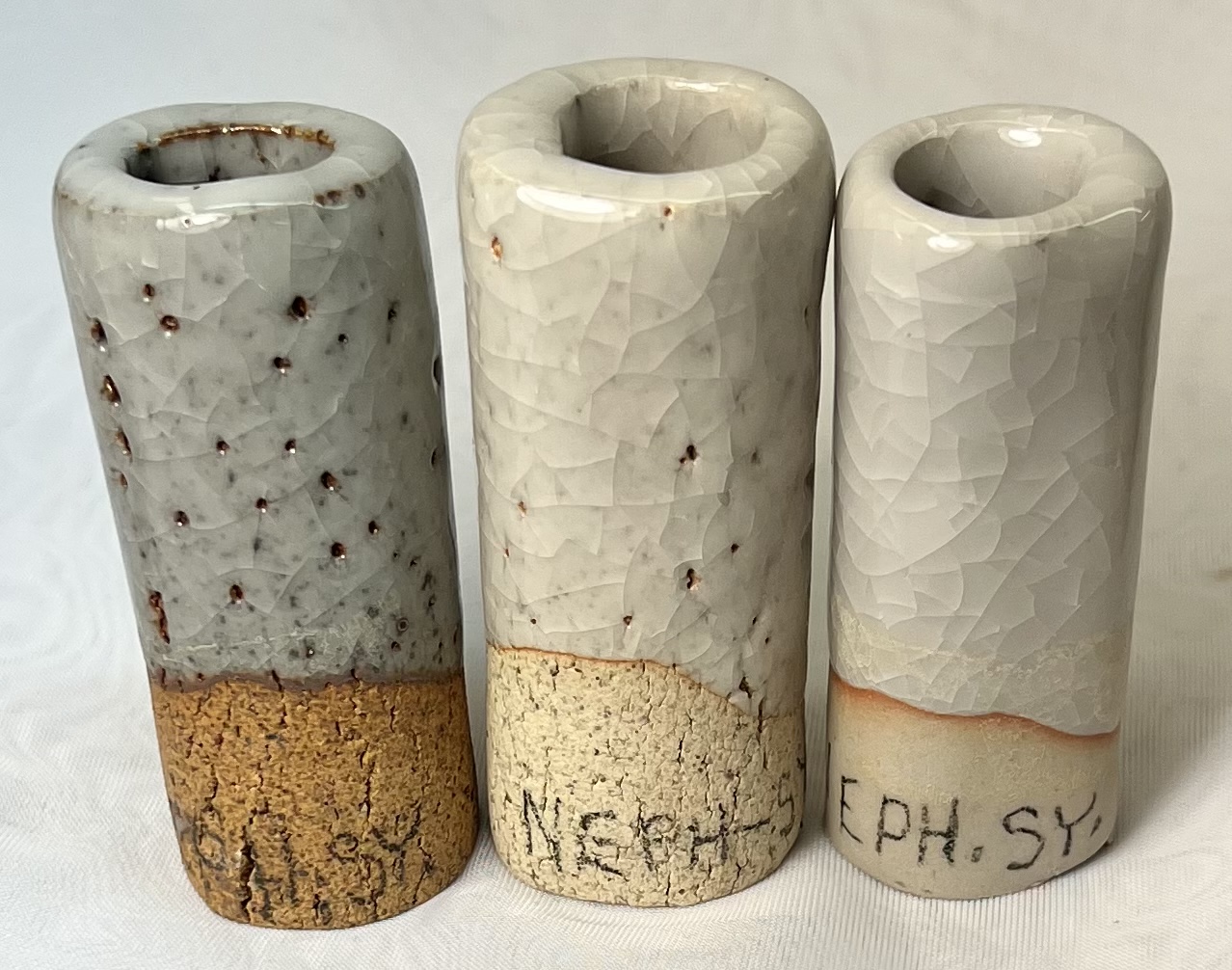
Pure Nepheline Syenite as a crackle glaze:
Its chemistry explains exactly why crackle glazes crack
Crackle glazes are often thought of simply as recipes that somehow produce a crack pattern. However, crackle is a glaze/body fit phenomenon, not simply an intrinsic visual property of the glaze. They have very high levels of Na2O and/or K2O (collectively, KNaO). These two have the highest co-efficients of thermal expansion, by far, of oxides commonly found in pottery glazes. Feldspars, and particularly nepheline syenite, can supply them in abundance.
Shown here is the 77E10A recipe, originally from Luke Lindoe. It is simply Nepheline Syenite and water (shown on three types of clay bodies). Think of it as an on-ramp to understanding more about this type of glaze. 77E10A1 and 77E10A2 are improvements on this, both provide a path to develop and adapt it for your needs.
Links
| Glossary |
Mechanism
Identifying the mechanism of a ceramic glaze recipe is the key to moving adjusting it, fixing it, reverse engineering it, even avoiding it! |
| Glossary |
Crackle glaze
Crackle glazes have a crack pattern that is a product of thermal expansion mismatch between body and glaze. They are not suitable on functional ware. |
 PayPal | No tracking, No ads, No paywall, No transient content! Just organized, concise information constantly updated and improved. Was this helpful? Consider supporting me. |
Got a Question?
Buy me a coffee and we can talk 

https://backup.digitalfire.com, All Rights Reserved
Privacy Policy