All Temperature Numbers Temperature Listing
450-650C (842-1202F)
Dehydroxylation in kaolin, ball clay
Dehydroxylation is the release of structurally bound hydroxyl groups from clay minerals such as kaolinite and ball clays during firing. Unlike dehydration (which removes physically held water), dehydroxylation involves the breakdown of hydroxyl groups in the crystal lattice, producing water vapor and transforming the clay mineral into an amorphous phase known as metakaolin. In ceramic bodies, this reaction typically begins around 450°C and is largely complete by about 600–650°C. In the manufacture of calcined kaolin, the process is considered essentially complete around this temperature. While some overlap exists between the loss of adsorbed water and the beginning of structural hydroxyl loss, it occurs well above the temperatures where free pore water is removed. Because the clay body has already become porous by this stage and the reaction proceeds gradually, dehydroxylation does not generate steam pressure problems.
Related Information
When kilns are not candled long enough
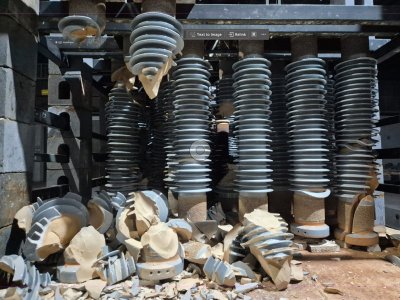
This picture has its own page with more detail, click here to see it.
Candling of kilns is the final stage of drying. Driers cannot achieve the temperatures needed to remove all water, so almost all industries rely on early stages of firing to remove it fully. Failures like this are part of the learning curve of every company (because there is always pressure to fire as fast as possible).
Although much more common in heavy clay industries, porcelain insulators are one of the less likely products for this to happen with. This is because machine-forming methods make it possible to use aluminous porcelain bodies having very little clay. Thus, faster drying (with less shrinkage and fewer residual internal stresses) also makes it possible for early stages of firing to be quicker. But there are limits. These insulators are solid, thick and heavy. And they have extreme variations in thickness (thin skirts to solid spindle). So, for even these, early stages of firing must be conducted carefully. For such products, periodic firings of days is often needed.
Links
| Glossary |
Calcination
Calcining is simply firing a ceramic material to create a powder of new physical properties. Often it is done to kill the plasticity or burn away the hydrates, carbonates, sulfates of a clay or refractory material. |
| Glossary | Dehydration |
| Temperatures | Pore water removed in clay bodies (80-250) |
| Temperatures | Metakaolin converts to spinel phase (950-1050) |
| Temperatures | Spinel phase meta kaolin converts to mullite (1050-1200+) |
| Minerals |
Mullite
Mullite (3Al₂O₃·2SiO₂) is a naturally occurring aluminum silicate crystalline mineral. It forms in h |
 PayPal | No tracking, No ads, No paywall, No transient content! Just organized, concise information constantly updated and improved. Was this helpful? Consider supporting me. |
| By Tony Hansen Follow me on        |  |
Got a Question?
Buy me a coffee and we can talk 

https://backup.digitalfire.com, All Rights Reserved
Privacy Policy