Fritware
A porcelain with significant added frit. The frit matures it at a far lower temperature than typical. The strength mechanism is one of particle glass bonding rather than mullite development.
Key phrases linking here: fritware - Learn more
Details
Photo not found
or not published
Photo not found
or not published
Where plasticity can be sacrificed, or augmented by binders, frit percentages can be increased to 90% or more in the recipe to get a vitreous body as low as cone 020! Using Veegum, such bodies can be plastic enough for forming and throwing. Using binders, even higher frit percentages can be tolerated for casting or pressing.
An advantage of fritware to potters is that standard low-temperature glazes can be used. This includes underglazes. Low-fire transparent glazes produce ultra-clear and brilliant surfaces not possible at higher temperatures. The edges of underglaze decoration also bleed much less. Of course, fritware must be bisque-fired at much lower temperatures (e.g. 1500-1600F or lower) to be absorbent enough for traditional porous-bisque glazing.
If you wish to experiment with fritware, consider mixing our Zero3 or Zero4 porcelains (and matching glazes).
Related Information
Zero4 fritware mugs fired at cone 04

This picture has its own page with more detail, click here to see it.
To a potter, it may seem impossible that a body can be this porcelain-like at such a low temperature. And that such a body can be as plastic as this is. Achieving these came at the cost of shrinkage, both drying and firing, 18% total (vs 14% of a Grolleg cone 10 porcelain). Using this Zero4 fritware, very thin-walled pieces can be thrown. The frit also produces a body having a higher thermal expansion, so it fits any low-temperature glaze we have tried. This glaze is G1916QL3 ultra gloss clear glaze on Amaco Velvet underglazes. The low temperature has another benefit: Very sharp edges on painted underglaze designs. Zero4 replaces my old Zero3 fritware with a body that works at a more common temperature. It also employs a tiny amount of blue stain to produce the bluish-white color. Like Zero3, you can also make this yourself.
Zero4 porcelain cup cross-section

This picture has its own page with more detail, click here to see it.
The fritware body is highly plastic and can be thrown very thin. At cone 04, this thin-walled mug did not warp even though it fired to a near-glasslike cross-section. The density and strength are amazing; it took about 30 hits with a hammer to break it, hitting it as hard as I dared without risking being cut (I was holding it by its handle). The whiter flecks are agglomerates of New Zealand kaolin (because of improper mixing of the slurry); later batches were much better.
Zero4 fritware is more resistant to overfiring than you might think

This picture has its own page with more detail, click here to see it.
Most technical sources would say that one of the disadvantages of fritware bodies is volatility in firing. They should deform and warp more readily as they reach maturity. And if overfired we would expect rapid increase in deformation. However, that is not the experience we have had with Zero4 low fire porcelain. It reaches zero porosity (maximum density by cone 06, 1800F). Yet it is still very stable at cone 04 which is more than 100F hotter. Also, at cone 04 it achieves very good translucency. But this cast piece, which is about 10 cm tall (4 in) has a wall thickness of only 2.5mm, has wide flat areas that have not warped and it is fired another 100F hotter (cone 02). Yet it is not warping! This body has the same density and firing shrinkage across the entire cone 06-02 range.
Firing a porcelain in less than 4 hours total

This picture has its own page with more detail, click here to see it.
This porcelain mug put into kiln at 8:45am and I was drinking coffee from it at 12:15! How? One way to fast-fire is to fire a lot lower. This is Zero3 porcelain made using Dragonite Halloysite (not quite as white-burning as New Zealand Halloysite). It is the L2934C recipe. It was fired to cone 03 and glazed with G2931K clear glaze (which has fired crystal clear and flawless). I fired at 1200F/hr to 1950F, held it for 15 minutes, cooled at 999F/hr to 1850F and held it for 30 minutes, then dropped as fast as the kiln would do. Is this really porcelain? Yes. And it is super strong. The frit in the recipe is magic, making it vitrify quickly and completely.
Casting Zero3 Porcelain

This picture has its own page with more detail, click here to see it.
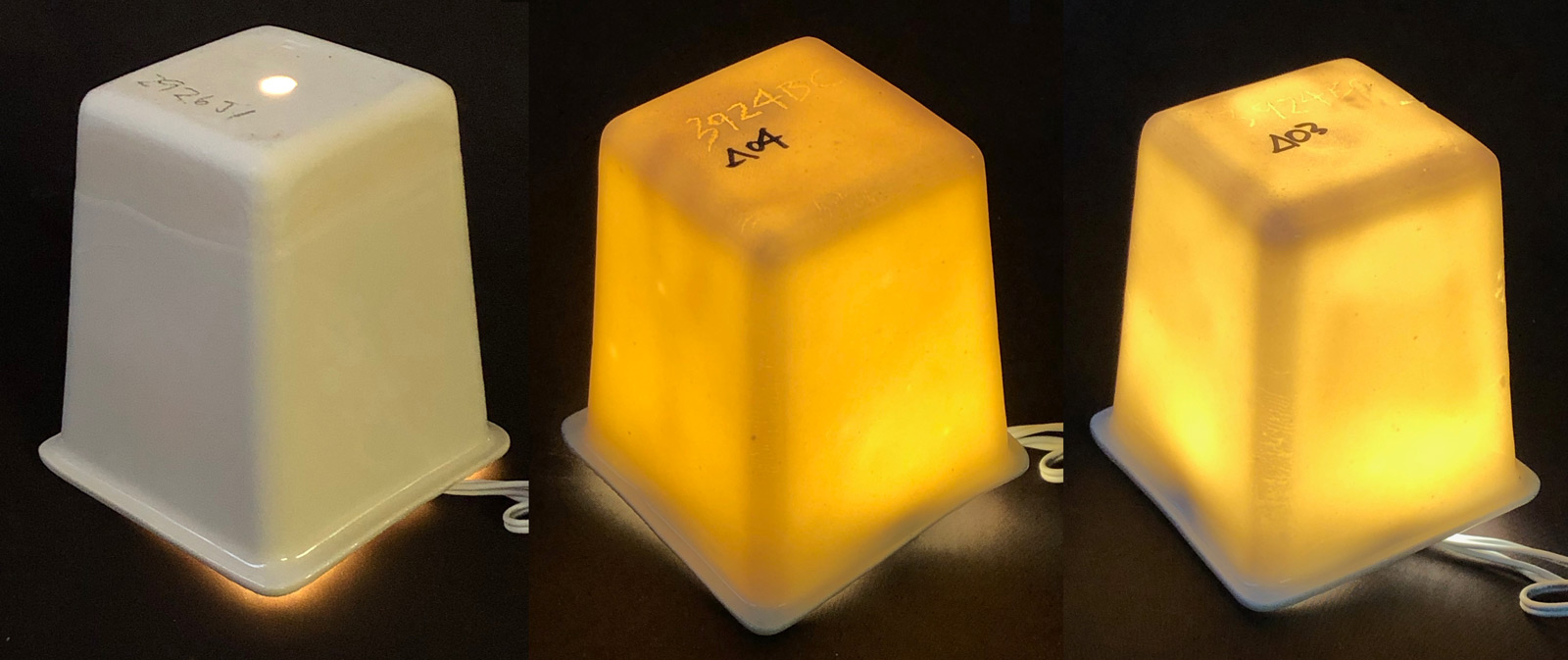
Look at how translucent this is! I can fire one of these in three hours, cold-to-cold. I am casting them with molds made using the 3D-printing process. Anyone could do this. Incredibly exciting. And with the G3879 glaze it looks awesome, just like bone china. Notwithstanding this, the Zero3 recipe has to be altered for casting. Initially I have reduced the VeeGum to 1% but it is still casting too slow. And it is not shrinking enough to pull away from the mold well. I am considering strategies on how to increase drying shrinkage and am going to add more frit to take it down to cone 04.
Zero3 casting porcelain at cone 04, 03
This picture has its own page with more detail, click here to see it.
Compared to a typical cone 6 porcelain, left, which has zero translucency, these are fired 10 cones lower. I am using the G3879 clear glaze and it is working very well.
Links
| URLs |
https://en.wikipedia.org/wiki/Fritware
Fritware at Wikipedia This page has a number of errors to be aware of. Glaze are not applied to harden objects, fritware is hard without them. Tin glazing is not needed for whiteness, it is just as white as porcelains. The frit used is not "crushed silica". It is not innovative because of body and glaze made of the same materials, it is innovative because frit is added to the body. A recipe of "10 parts silica to 1 part glass frit and 1 part clay" is impossible. |
| Glossary |
Bone China
A ceramic whose priorities are translucency, whiteness, fired strength and resistance to thermal shock failure. |
| Glossary |
Zero3
The designation for a group recipes for body, glaze and engobe (by Tony Hansen), that potters can use to make low fire stoneware and fritware porcelain at 1100C (2000F) or cone 03. |
| Materials |
Ferro Frit 3110
High sodium, high thermal expansion low boron frit. A super-feldspar in clay bodies. Melts at very low temperatures. Useful to make crackle glazes. |
| Materials |
Veegum
A clay of incredibly small particle size. It has the highest plasticity of any known clay and acts as a suspending and gelling agent in slurries. |
 PayPal | No tracking, No ads, No paywall, No transient content! Just organized, concise information constantly updated and improved. Was this helpful? Consider supporting me. |
| By Tony Hansen Follow me on        |  |
Got a Question?
Buy me a coffee and we can talk 

https://backup.digitalfire.com, All Rights Reserved
Privacy Policy