Blue Grey Plastic
Alternate Names: 98 Blue Grey Plastic, 98 BGP
Description: Highly plastic red burning earthenware
| Oxide | Analysis | Formula | Tolerance |
|---|---|---|---|
| Al2O3 | 15.35% | 1.44 | |
| SiO2 | 66.90% | 10.63 | |
| Fe2O3 | 3.72% | 0.22 | |
| CaO | 0.49% | 0.08 | |
| K2O | 3.25% | 0.33 | |
| MgO | 1.58% | 0.37 | |
| Na2O | 1.33% | 0.20 | |
| Cr2O3 | 0.01% | - | |
| MnO | 0.02% | - | |
| P2O5 | 0.11% | 0.01 | |
| SrO | 0.01% | - | |
| TiO2 | 0.50% | 0.06 | |
| LOI | 6.80% | n/a | |
| Oxide Weight | 890.28 | ||
| Formula Weight | 955.24 | ||
Notes
An extremely plastic red burning fine-grained material from the Elkwater area in southern Alberta. It was used in brick manufacture and in pottery clay bodies and it was still in use in the production of Alberta Slip in 2024. This was a successor to 45R.
Ba ppm: 1006
Cr ppm: 39
Ni ppm: 34
SO3: 0.04
Sr ppm: 66
V ppm: 78
Loring Labs analysis 2006 showed 16.2 Al2O3, 64.0 SiO2, 4.6 LOI, 4.55 FeO3, 2.7 SO3.
Related Information
Redart fired bars vs. Plainsman Blue Grey Plastic

This picture has its own page with more detail, click here to see it.
The Redart clay bars (left) are fired at cones 06, 04, 2, 4 & 5 (top to bottom). The Plainsman Blue Grey Plastic bars (right) are fired at 06, 04, 03, 02, 2 & 4. The SHAB test procedure (used to make these) gives us the firing shrinkage and porosity at each temperature, these are direct indicators of the fired maturity. And it enables comparing the fired color and surface character. Notice how much the color changes with increasing temperature. The fired maturity is pretty similar but the BGP is a little browner. It is also much more plastic (the drying shrinkage is significantly higher).
Yixing clay teapots
Could you make the clay?
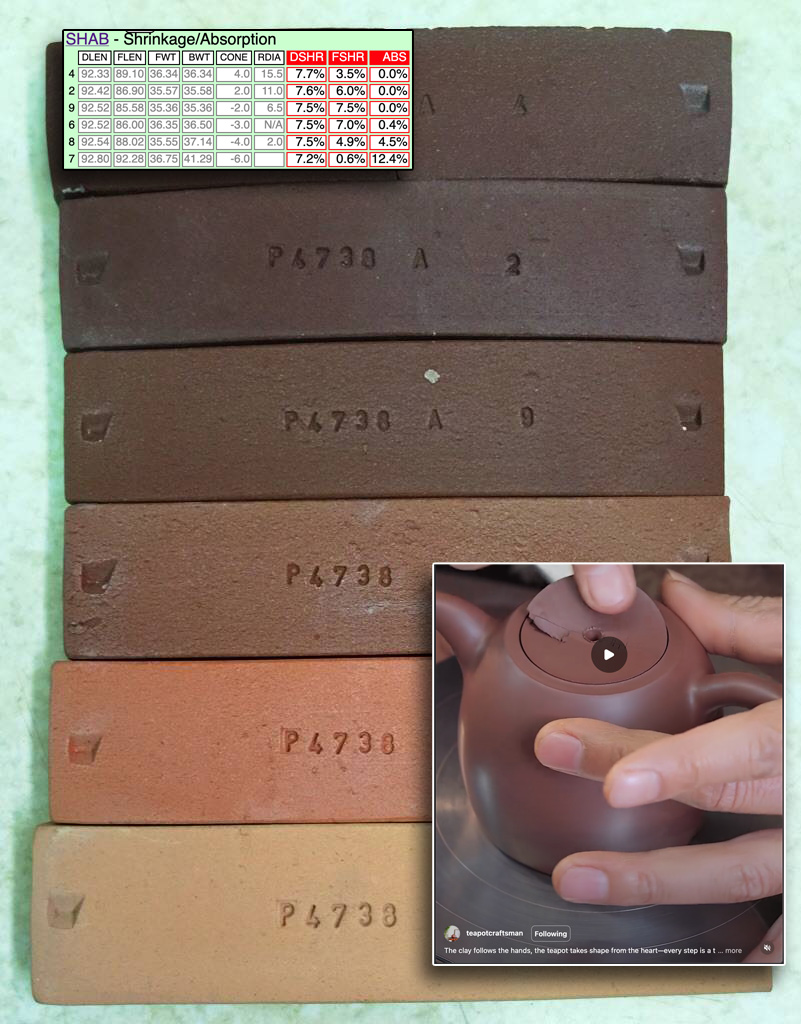
This picture has its own page with more detail, click here to see it.
This clay is called 98BGP, it was mined in Southern Alberta in the 1990s (not for sale now). It is greenish in the wet state. Terracotta clays like this are widely available. Redart is a terracotta. This one is very smooth, but most have some grit. A potter willing to do a program of testing and record-keeping (with lots of pictures) and adapt technique to the material should be able to make this work. These fired test bars show that achieving the desired surface and density is a matter of firing temperature. The #9 bar is fired at cone 02 with 0% porosity, which is porcelain density and thus unsuitable. But the third one up is cone 03, it has 0.4% porosity. It just needs a surface enhancer to provide the sheen. Many terracotta clays have soluble salts that will ruin the appearance, but a surface enhancer will erase them.
Links
| Typecodes |
Clay Other
Clays that are not kaolins, ball clays or bentonites. For example, stoneware clays are mixtures of all of the above plus quartz, feldspar, mica and other minerals. There are also many clays that have high plasticity like bentonite but are much different mineralogically. |
| Materials |
98 Mix
|
 PayPal | No tracking, No ads, No paywall, No transient content! Just organized, concise information constantly updated and improved. Was this helpful? Consider supporting me. |
| By Tony Hansen Follow me on        |  |
Got a Question?
Buy me a coffee and we can talk 

https://backup.digitalfire.com, All Rights Reserved
Privacy Policy