Diatomaceous Earth
Alternate Names: Diatomite
| Oxide | Analysis | Formula | Tolerance |
|---|---|---|---|
| CaO | 1.00% | 0.36 | |
| Al2O3 | 5.00% | 1.00 | |
| SiO2 | 87.00% | 29.53 | |
| Fe2O3 | 1.00% | 0.13 | |
| LOI | 6.00% | n/a | |
| Oxide Weight | 1,917.60 | ||
| Formula Weight | 2,040.00 | ||
Notes
Diatomaceous earth (DE) is a marine sediment consisting primarily of the skeletons of diatoms (microscopic free-swimming algae that build their ornate 'silica houses' from SiO2 in seawater).
Deposits are located in California, Kenya, southern British Columbia, and elsewhere where there are uplifted marine sediments. Johns Manville has a large mine in Lompoc, California, where ridges of hills expose large amounts of the white, solid material. These deposits are rich in marine fossils on display at a local museum.
Diatomite, the raw parent material, is fairly soft. Diatomaceous earth is used as a refractory ingredient in bricks, etc., as a mild abrasive, as an insulation in boilers and furnaces, and in filtering systems. Potters may use this to create "lightweight" clay bodies or refractory washes.
The material is not typically pulverized to a fine powder, the way silica is. But it is normally calcined. While pure diatomaceous earth is chemically silica, its physical structure is what matters most. Because the skeletons are hollow and ornate, it has a massive surface area and high porosity.
Safety Warning. While DE is amorphous silica, it can contain crystalline silica (especially if calcined, which is most common with commercially available grades). Commercial versions also can feel "soft" or "chalky" to the touch; users may assume it is safer than the gritty feel of sand or the heavy weight of silica flour. This is a dangerous misconception. Because DE is so lightweight, it stays airborne much longer than standard quartz, making it easier to breathe in accidentally. Use a NIOSH-approved N95 or P100 respirator
Related Information
Raw diatomaceous earth. Is it a clay?
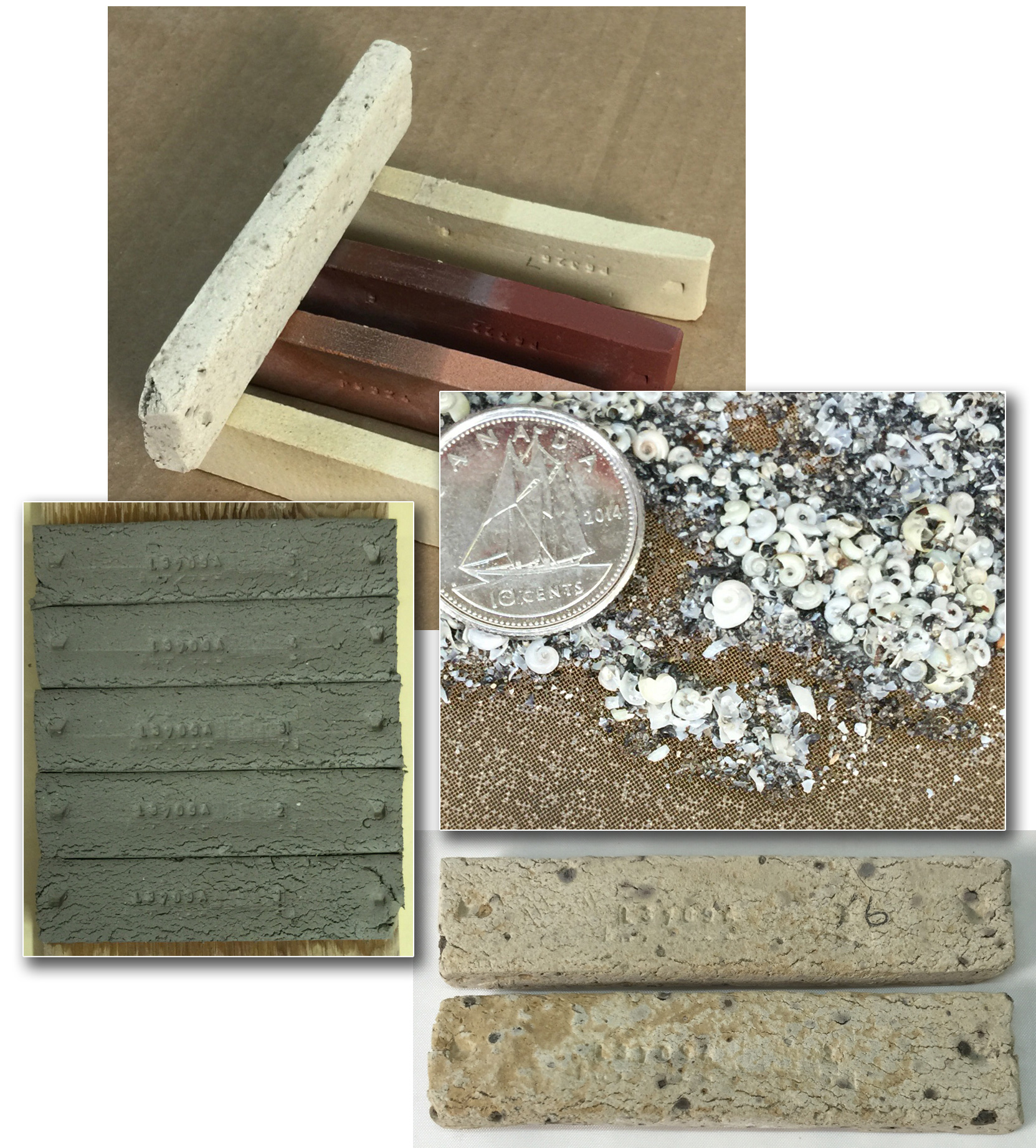
This picture has its own page with more detail, click here to see it.
Or, more correctly, is this one a clay? The way I found out was to test it myself. That's what I did.
The giveaway of its marine origin is the tiny shells found on the sieve. The Cretaceous Sea once connected the Arctic Ocean with the Gulf of Mexico, covering the great plains of North America. Sedimentation left this deposit of Diatomaceous earth in central Alberta, Canada. This sample contains enough clay that I was able to slurry it up, dewater it on a plaster bat and then prepare SHAB test bars to try it at five temperatures. At cone 10 (bottom right) the porosity is 62%! And the LOI is 32% (others can go as high at 50%). Why? Raw diatomaceous earth contains physically bound interlayer water, it leaves by ~100–300 °C. It also contains structural hydroxyl water (in clay minerals or hydrated silica phases). This “chemical water” burns off between ~400–700 °C. And, organic matter from ancient algae, plants, or soil contamination also burns out between ~300–800 °C (as CO₂ and other gases). Finally, the carbonates (e.g. shells shown here) decompose around 700–900 °C, releasing CO₂. That alone can cause a big weight loss.
Note the test bars under it. Where this bar was sitting there is glassy deposit. What is that? Diatomaceous earth is mostly amorphous silica, but it almost always contains alkali and alkaline-earth impurities and sometimes boron. The latter can literally drain out, as a liquid. However here, the alkalis have volatilized (vaporized) or form alkali-rich fumes. These landed on nearby surfaces to react with the other test bars to form a thin alkali-silicate glass layer (similar to what happens in soda firing).
Links
| Materials |
Fuller's Earth
|
| Typecodes |
Clay Other
Clays that are not kaolins, ball clays or bentonites. For example, stoneware clays are mixtures of all of the above plus quartz, feldspar, mica and other minerals. There are also many clays that have high plasticity like bentonite but are much different mineralogically. |
| Typecodes |
Generic Material
Generic materials are those with no brand name. Normally they are theoretical, the chemistry portrays what a specimen would be if it had no contamination. Generic materials are helpful in educational situations where students need to study material theory (later they graduate to dealing with real world materials). They are also helpful where the chemistry of an actual material is not known. Often the accuracy of calculations is sufficient using generic materials. |
| Hazards |
Diatomaceous Earth Toxicology
|
| URLs |
http://en.wikipedia.org/wiki/Diatomite
Diatomite at Wikipedia |
 PayPal | No tracking, No ads, No paywall, No transient content! Just organized, concise information constantly updated and improved. Was this helpful? Consider supporting me. |
| By Tony Hansen Follow me on        |  |
Got a Question?
Buy me a coffee and we can talk 

https://backup.digitalfire.com, All Rights Reserved
Privacy Policy